Strategic Approaches to Online Reputation Management

Online reviews hold immense power. By August 2026, a staggering 83% of consumers read Google reviews when making decisions about businesses. These reviews directly influence public perception and a company’s bottom line.
However, negative feedback can appear for many reasons. Sometimes, these reviews are unfair, inaccurate, or even violate Google’s content policies. Such reviews can harm your brand’s reputation and deter potential customers.
We understand the challenges this presents. This extensive guide will equip you with the knowledge to effectively manage your online reputation. We will explore legitimate strategies to address and remove policy-violating Google reviews. You will learn the step-by-step process for reporting, appealing, and protecting your business from harmful online content.
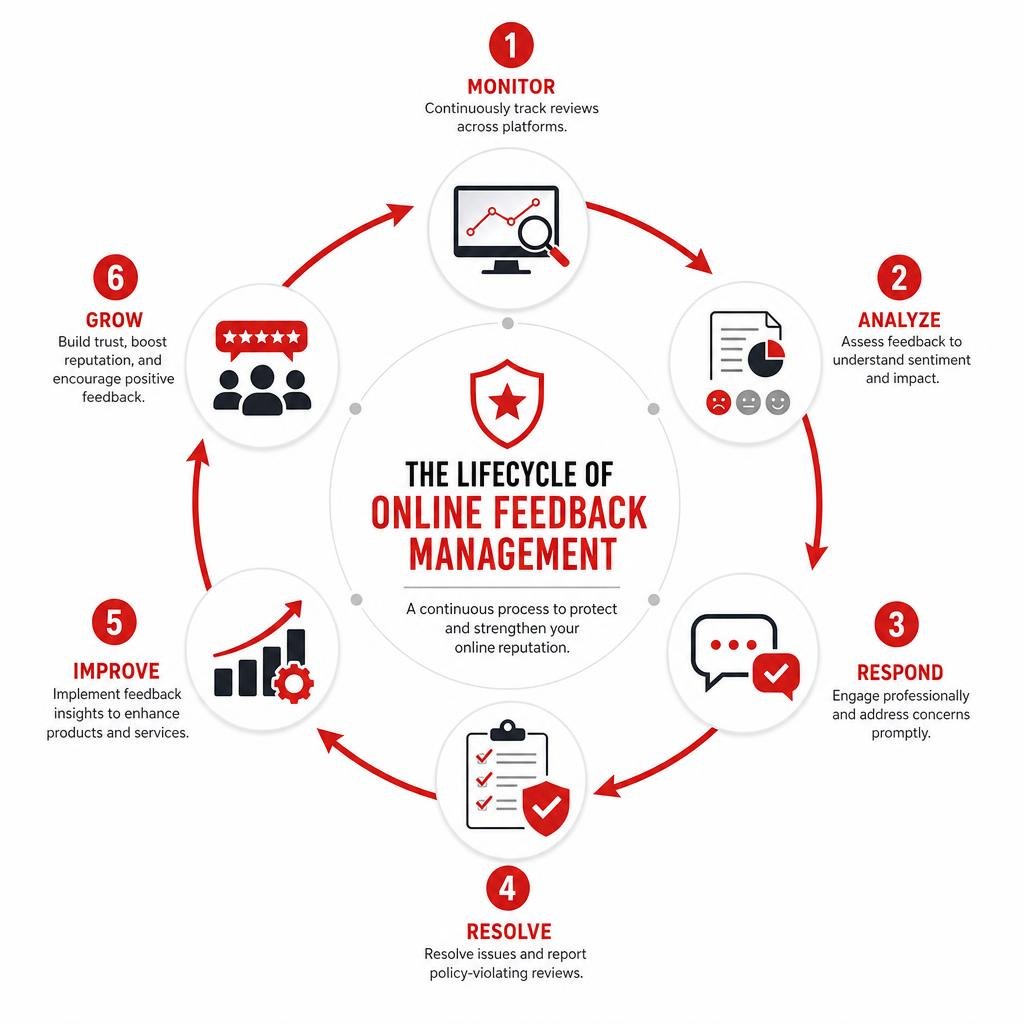
Effective online reputation management (ORM) is more than just reacting to negative feedback; it’s a proactive strategy to shape how your brand is perceived. It involves continuously monitoring customer sentiment, understanding review velocity, and actively working to enhance your brand equity and digital footprint. A strong ORM strategy contributes significantly to positive public perception and, ultimately, customer retention. Ignoring online reviews, whether positive or negative, is no longer an option for businesses aiming for sustainable growth in the digital age.
Integrating Online Reputation Management into Customer Operations
Integrating ORM into your daily customer operations is crucial for a holistic approach. This means establishing clear protocols for review tracking, ensuring consistent customer engagement, and creating feedback loops that inform both your customer service and product development. Sentiment analysis tools can help you quickly gauge the overall mood surrounding your brand, allowing you to prioritize responses and identify recurring issues. Developing robust response protocols ensures that every piece of feedback, especially negative ones, is addressed promptly and professionally, often directly through your customer support channels. This proactive engagement can often de-escalate situations before they become entrenched negative reviews.
Recognizing Inappropriate Content and Platform Violations
The first step in addressing negative Google reviews is to understand what constitutes a legitimate reason for removal. Google’s content guidelines are extensive, and not every negative review qualifies. We cannot remove reviews simply because we dislike them or disagree with the customer’s assessment. Google explicitly states that it will not mediate factual disputes or verify the truthfulness of a customer’s experience.
However, there are clear violations that Google will act upon. These fall under categories like “Prohibited and Restricted Content” and “Fake Engagement.” Identifying which of these policies a negative review violates is critical for successful removal.
Common policy violation triggers include:
- Fake Engagement: Reviews that are not based on a real experience, are posted by competitors, or are part of a coordinated attack (e.g., review bombing). This also includes reviews posted by someone on behalf of another person (“My friend used them…”).
- Conflict of Interest: Reviews posted by current or former employees, or by individuals with a direct personal or financial stake in the business (e.g., an opposing party in a legal dispute).
- Off-Topic Content: Reviews that are irrelevant to the business or the customer’s experience (e.g., a review for a hardware store complaining about sushi). This also includes complaints solely about the driving behavior of a company’s service vehicle, as it doesn’t reflect direct engagement with the business location.
- Illegal Content: Content that promotes illegal activities.
- Terrorist Content: Any content that promotes terrorism.
- Sexually Explicit Content: Content of a sexual nature.
- Offensive Content: Hate speech, harassment, bullying, or content that promotes violence or discrimination. While calling someone a “racist” might not be hate speech, using racist language certainly is.
- Dangerous & Derogatory Content: Threats, incitement to violence, or content that degrades individuals or groups.
- Privacy Violations: Reviews that reveal private, personally identifiable information about individuals.
- Misinformation: Content that is demonstrably false or misleading, particularly concerning public health or civic processes.
- Impersonation: Reviews posted by someone pretending to be another person or entity.
- Misuse of Personal Information: Reviews that include non-public employee full names (though policies shifted around 2024-2025 to allow names of public-facing professionals like doctors or lawyers).
- Unsubstantiated Allegations: Accusations of unethical or criminal wrongdoing without evidence.

Understanding these categories is paramount. We must anchor our removal requests strictly to these guidelines, rather than simply expressing dissatisfaction with the review’s content.
Resolving Policy-Violating Search and Map Reviews
When a review clearly violates Google’s policies, we have direct mechanisms to address it. Google provides tools designed for platform compliance, enabling business owners to initiate dispute resolution processes. Our goal is to protect our brand and maintain the integrity of our Business Profile by removing content that undermines these principles.

Step-by-Step Reporting Mechanisms
Hundreds of thousands of Google Business Profile users search every month for information on how to get a Google review removed, highlighting the widespread need for clear guidance. Here’s the step-by-step process for reporting a review through Google’s tools:
- Access Your Google Business Profile: Log into your Google Business Profile account.
- Navigate to Reviews: From your dashboard, select “Read reviews” or go to the “Reviews” section.
- Identify the Violating Review: Locate the specific negative review you wish to report.
- Flag the Review: Click the three vertical dots next to the review and select “Report review.”
- Choose a Violation Category: Google will present a list of reasons for reporting. Select the category that best fits the violation. Common options include “Spam,” “Off-topic,” “Hate speech,” “Privacy concern,” or “Conflict of interest.” Choose carefully, as this initial selection guides Google’s review.
- Submit Your Report: Confirm your selection.
Most reported reviews are processed within 3 business days. You can track the status of your reported reviews in the Reviews Management Tool. The status labels you might see include “Decision pending,” “Report reviewed – no policy violation,” or “Escalated.”
For coordinated review attacks or multiple policy-violating reviews, the Reviews Management Tool allows us to select up to 10 reviews simultaneously for batch reporting. This can be particularly useful if your business is experiencing “review bombing” due to viral social media or news outrage.
Preparing Evidence and Filing Structured Appeals
If Google initially rejects your report or the status indicates “no policy violation,” we have the option to submit a one-time appeal. This is where our preparation and structured approach become critical.
- Document Everything: Gather all relevant evidence. This could include screenshots of the review, links to the reviewer’s profile, and any external information that supports your claim of a policy violation. If the review is off-topic, highlight the specific phrases that prove it (e.g., “This hardware store sold me bad sushi”).
- Identify Specific Policy Violations: Re-read Google’s content policies. Pinpoint the exact policy or policies the review violates. Do not simply state you disagree with the review; clearly articulate how it breaches Google’s rules. For instance, if a review contains unsubstantiated allegations of criminal behavior, cite the “Illegal Content” or “Dangerous & Derogatory Content” policies.
- Craft Your Appeal: When submitting an appeal through the Reviews Management Tool (under “Appeal eligible reviews”), provide concise, objective documentation. Avoid emotional language.
- Be Specific: Reference the review’s URL and point to the exact phrases or elements that violate policy.
- Cite Policies: Explicitly mention the Google policy (e.g., “This review violates Google’s ‘Fake Engagement’ policy because the reviewer states they are posting on behalf of their mother, indicating they lack a experience.”).
- Define Terms: If the review uses slang or ambiguous terms that constitute a violation (e.g., calling someone a “crook” to imply criminal behavior), use standard dictionary definitions (like Oxford Languages) to clarify its meaning and how it violates the policy on unsubstantiated allegations. This is especially helpful as Google’s support reviewers may be non-native English speakers.
- Focus on Google’s Perspective: Google will not mediate factual disputes. Arguing that a reviewer is “lying” or was “never a customer” is typically ineffective. Google accounts do not require verified real names, and users can review businesses based on any experience, not just a transaction. Focus instead on violations that Google’s algorithm or human reviewers can objectively verify against their policies.
- Batch Appeals: If multiple reviews are part of a coordinated attack, appeal them as a batch (up to 10 at a time) to demonstrate a pattern of abuse.
Common Mistakes to Avoid:
- Reporting solely based on negative sentiment: Google does not remove reviews just because they are negative.
- Claiming the reviewer isn’t a customer: Google doesn’t verify customer status by name.
- Disputing facts: Google won’t mediate disputes over the truthfulness of a review.
- Using emotional language: Stick to objective facts and policy citations.
- Failing to provide evidence: Screenshots and direct links are crucial.
- Giving up after the first rejection: The appeal process is your second chance.
If a clear policy violation remains unaddressed after the appeal, you can escalate the issue to the Google Business Profile Community forum. Product Experts there may be able to provide further guidance or escalate your case internally with a Case ID.
Risk Mitigation, Scams, and Regulatory Compliance
Beyond legitimate policy violations, businesses must also contend with the darker side of online reviews: review extortion, review bombing, and other forms of brand sabotage. Navigating these threats requires vigilance and a clear understanding of regulatory compliance.

Identifying Black-Hat Online Reputation Management Practices
While we focus on legitimate removal methods, it’s important to be aware of unethical tactics some companies use to “remove” reviews and why we should avoid them. These “black-hat” online reputation management practices often exploit automated systems and can lead to severe consequences for your business.
- Fraudulent DMCA Takedowns: Some firms abuse the Digital Millennium Copyright Act (DMCA) by filing false copyright claims against negative reviews or articles. They might claim a review copied content from an unrelated source (like an earthquake news story, as one anecdote describes) to trigger automated delisting from search results. Google often automates the approval of these requests without manual review, creating a loophole. However, this is illegal and can result in legal penalties, content reinstatement, and significant reputational damage if exposed.
- Automated Flagging/Mass Reporting: These services orchestrate mass reporting campaigns to trigger automated platform takedowns. While this might temporarily remove content, human moderators often reinstate it once the coordinated spam is identified.
- Exploiting Moderation Loops: Some services try to find specific keywords or phrases that trigger automated moderation systems, even if the content itself isn’t a clear violation.
Why should we avoid these tactics?
- Ethical Concerns: Using fraudulent methods is fundamentally dishonest and akin to buying fake positive reviews.
- Legal Risks: False DMCA claims can lead to lawsuits, fines, and criminal charges.
- Reputational Damage: If exposed, using black-hat tactics can severely damage your brand’s credibility, often far worse than the original negative review.
- Temporary Solutions: Content removed through these means can often be reinstated by platforms or re-indexed by search engines, leading to wasted time and money.
- Regulatory Penalties: Governments and regulatory bodies are increasingly cracking down on deceptive online practices.
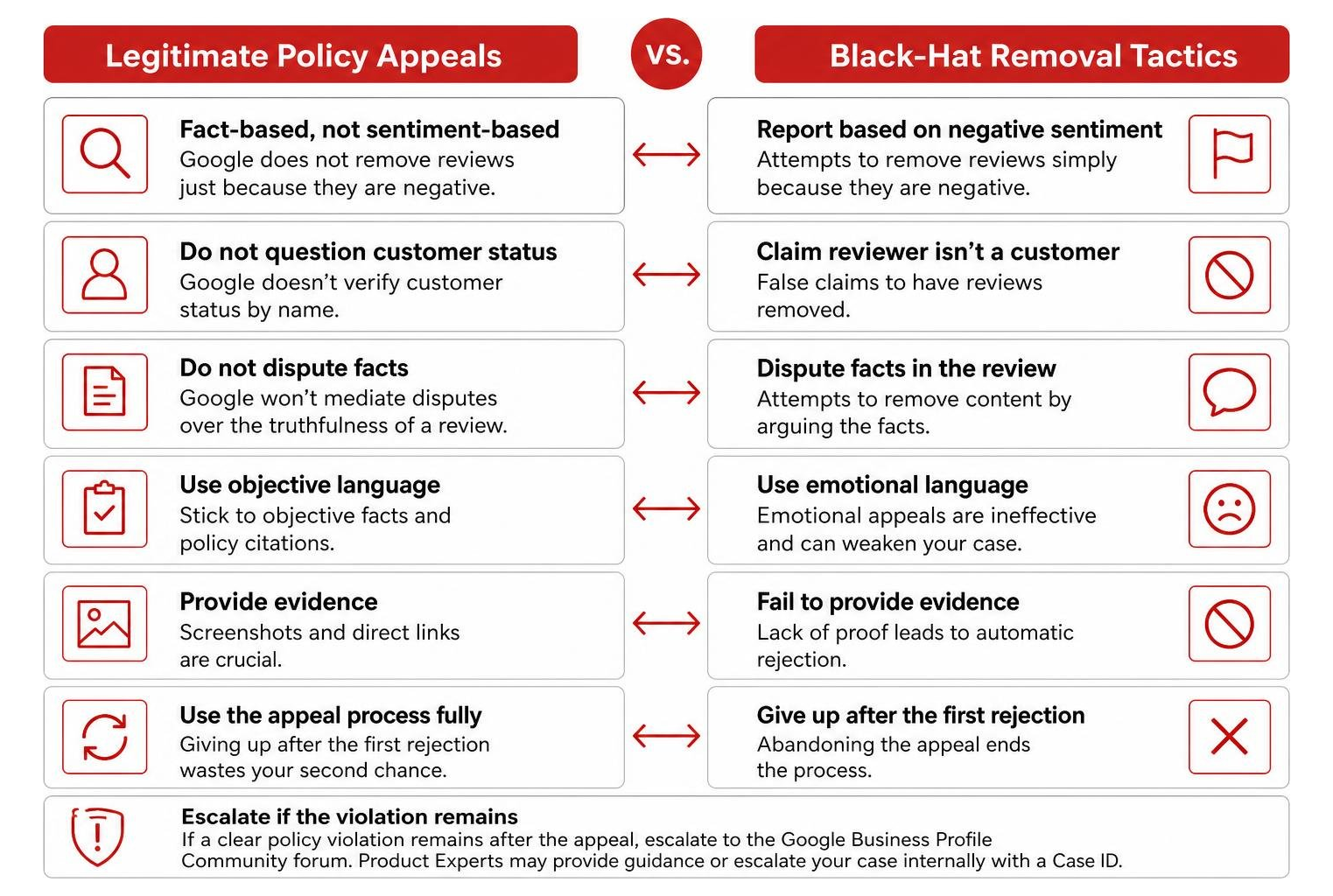
We advocate for transparent, ethical reputation management that adheres strictly to platform guidelines and legal frameworks.
Responding to Unresolved Feedback and Crisis Management
Even with the best efforts, some negative reviews that don’t violate Google’s policies will remain. In these cases, our strategy shifts to effective response and crisis management.
- Respond Publicly and Professionally: A thoughtful, empathetic public response can often mitigate the impact of a negative review. Acknowledge the customer’s experience, apologize if appropriate, and offer to resolve the issue offline. This demonstrates to potential customers that you are attentive and care about customer satisfaction.
- Example: “We’re truly sorry to hear about your experience. We pride ourselves on excellent service, and we’d like to understand more about what happened. Please contact us directly at [phone number] or [email address] so we can make things right.”
- De-escalation and Customer Remediation: Focus on turning a negative experience into a positive one. Sometimes, a direct outreach and a genuine effort at service recovery can lead the customer to update or remove their review voluntarily.
- Communication Transparency: Be transparent about your business practices and how you handle feedback. This builds trust.
- When to Consider Professional Intervention: For situations demanding specialized expertise, particularly when facing complex or persistent online attacks, engaging a firm that proactively removes negative online content can be a strategic decision. This might include instances of severe defamation, persistent harassment, or when legal remedies (like court orders or cease and desist letters) become necessary. Professionals can navigate these intricate legal and technical landscapes, offering solutions beyond what Google’s standard reporting tools provide.
Frequently Asked Questions About Online Review Disputes
We often encounter common questions regarding the nuances of review dispute resolution and policy enforcement. Let’s address some of these to provide clarity on platform guidelines.
Will a platform delete a negative review simply because the reviewer was never a customer?
No, Google will not remove a negative review simply because you claim the reviewer was never a customer or because you cannot find their name in your transaction records. This is a common misconception and a mistake many businesses make when trying to dispute reviews.
Google’s policy allows users to post reviews under account pseudonyms, and they are not required to use their legal names. Furthermore, Google does not require reviewers to be paying customers to leave a valid review. Anyone who has had an “experience” with your business, even if it didn’t involve a direct transaction (e.g., they visited your location, observed your service vehicle, or interacted with your staff), is generally permitted to leave a review, provided it adheres to other content policies. Google maintains a stance of platform neutrality and does not mediate factual disputes between businesses and consumers.
What should a business do if an initial review removal request is rejected?
If your initial report for review removal is rejected, or if the status in the Reviews Management Tool is “Report reviewed – no policy violation,” don’t give up immediately. You have a crucial next step: the one-time appeal.
- Review the Rejection: Carefully consider why Google might have rejected the initial report. Did you select the most accurate violation category? Was your reasoning clear?
- Utilize the Appeal Workflows: Go back to the Reviews Management Tool. You should see an option to “Appeal eligible reviews.”
- Prepare Stronger Evidence: This is your opportunity to provide more detailed information. As discussed earlier, cite specific Google policies, provide clear evidence (screenshots, links), and define any ambiguous terms. Focus on objective violations that Google can verify.
- Submit the Appeal: You can appeal up to 10 reviews at once if they are part of a similar incident.
- Community Escalation: If your appeal is also rejected, and you are certain the review violates a clear policy, consider posting your case (with a Case ID, if available) to the official Google Business Profile Community forum. Product Experts there might be able to offer further assistance or escalate the issue internally.
How can a business safely handle review extortion threats?
Review extortion scams are a serious threat where individuals or groups demand payment or other concessions to remove a negative review or prevent one from being posted. Protecting your business from these scams is critical.
- Do Not Engage or Pay: The most important rule is never to pay or negotiate with an extortionist. This only encourages further attempts and validates their tactic.
- Document Everything: Preserve all evidence of the extortion attempt. This includes screenshots of the review, any messages, emails, or communications from the extortionist, and details of their demands.
- Report to Google: Google has specific reporting mechanisms for extortion. Use the “Report a problem” feature within your Google Business Profile or the dedicated security reporting flow if available. Provide all your documented evidence. Google takes extortion very seriously as it violates their “Fake Engagement” policy.
- Report to Law Enforcement: Depending on the severity and nature of the threat, consider reporting the incident to local law enforcement or relevant cybercrime units.
- Risk Mitigation: While Google is investigating, continue to respond professionally to any existing negative reviews (without acknowledging the extortionist). Focus on acquiring new, legitimate positive reviews to dilute the impact of any potentially extorted reviews.
Conclusion
In the dynamic digital landscape of August 2026, proactive online reputation management is no longer a luxury but a necessity for brand defense and sustainable growth. By understanding Google’s policies, diligently following the step-by-step processes for reporting and appealing reviews, and recognizing the pitfalls of unethical practices, we can effectively safeguard our brand’s image.
Maintaining a positive online presence fosters consumer trust and reflects operational excellence. While negative feedback is inevitable, our ability to strategically address policy-violating content and professionally respond to legitimate criticism ultimately defines our brand’s resilience and commitment to our customers. Let us embrace these tools and strategies to build and protect a reputation that truly reflects the value we bring to the world.
