The Modern Landscape of Digital Marketing and SEO Strategies
The digital marketing landscape in 2026 is characterized by unprecedented complexity and opportunity. Search engines have evolved far beyond simple keyword matching, now incorporating sophisticated AI and machine learning algorithms to understand user intent with remarkable precision. This shift has given rise to generative engines, where AI models directly answer queries, often without users ever clicking through to a website. For businesses, this means rethinking how visibility is achieved and how customer intent is captured across a fragmented digital journey. We must move beyond isolated tactics and embrace a holistic approach that maps directly to the customer’s decision-making process, from initial awareness to conversion.
Building Unified Digital Marketing and SEO Strategies for Full-Funnel Growth
A truly effective digital marketing and SEO strategy in 2026 is not a collection of disparate activities but a unified, full-funnel system designed to drive business outcomes. This begins with a deep understanding of our audience. We segment our target customers, developing detailed personas that go beyond demographics to capture their motivations, pain points, and, crucially, their research pathways. Where do they start their search? Which platforms do they trust? How do their queries evolve as they move closer to a purchase decision?
By mapping these research pathways, we can identify intent clusters – groups of keywords and topics that reflect specific stages of the buyer journey (informational, navigational, commercial, transactional). For instance, a user searching for “what is help desk software” has different intent than one searching for “best help desk software for mid-market.” Our strategy must then align content, technical optimizations, and promotional efforts to meet these varied intents at every touchpoint. This data-driven approach ensures that our efforts are not just generating traffic, but attracting the right kind of traffic that is poised for conversion. Leveraging robust analytics and insights from platforms offering data-driven marketing resources can significantly enhance this process, allowing us to continuously refine our understanding of customer behavior and optimize our strategies for maximum impact.
Generative Engine Optimization and AI Citations
One of the most significant shifts in the 2026 search landscape is the rise of Generative Engine Optimization (GEO). With AI Overviews and other answer engines providing direct answers to user queries, a substantial portion of informational searches now result in zero-click outcomes. This means that merely ranking for a keyword is no longer sufficient; our content must be structured and authoritative enough to be cited by AI language models (LLMs).
Our GEO strategy focuses on earning “citation share” within these AI-generated summaries. This involves creating highly authoritative, encyclopedic content that includes clear, quotable passages – short, factual blocks of text that an AI can easily extract and attribute. We emphasize entity authority, ensuring that our brand, products, and key concepts are consistently represented and understood across the web. This is not about keyword stuffing, but about demonstrating deep expertise and trustworthiness (E-E-A-T) through well-researched, structured content. An AI-powered SEO platform can be instrumental in monitoring AI citations, identifying opportunities for content optimization, and tracking our performance in this evolving search environment, helping us to proactively adapt our content strategies to meet the demands of AI-driven search.
Core Pillars of High-Impact Organic Visibility

Achieving high-impact organic visibility in 2026 relies on a robust foundation built upon several interconnected pillars: technical excellence, comprehensive topical authority, strategic link acquisition, and precise entity markup. Neglecting any one of these can undermine the effectiveness of the others, making a holistic approach absolutely critical.
Technical Health and Core Web Vitals
Technical SEO remains the non-negotiable foundation of any successful organic strategy. Even the most brilliant content will remain invisible if search engine crawlers cannot efficiently discover, index, and render it. Our focus here includes meticulous management of crawl budget, ensuring that search bots prioritize our most important pages. We regularly audit indexation status, addressing any issues that prevent our content from appearing in search results.
Mobile performance is paramount, with responsive design and fast loading times being critical for both user experience and search engine rankings. Core Web Vitals (Largest Contentful Paint, Interaction to Next Paint, Cumulative Layout Shift) are direct measures of user experience that significantly influence visibility. Pages that meet these thresholds see substantially fewer user abandonments. Furthermore, we implement structured data (schema markup) to provide search engines with explicit information about our content, helping us earn rich snippets and improve our appearance in search results, including potential AI Overviews. Consistent site speed optimization, image compression, and efficient server responses are ongoing priorities to ensure a seamless experience for all users, regardless of device.
Content Architecture and Topical Authority
Building topical authority is central to our content strategy. Instead of chasing individual keywords, we aim to establish our brand as a comprehensive, trusted resource for specific subjects. This is achieved through a pillar-and-cluster content model. Pillar pages serve as comprehensive guides on broad topics, while cluster articles delve into specific subtopics, all interlinked to reinforce semantic relevance and authority. This architecture not only helps search engines understand the depth of our expertise but also provides a superior user experience, guiding visitors through related content.
Our content is crafted with semantic search in mind, anticipating the nuances of user queries and providing thorough, well-resestructured answers. We understand that zero-click answers are a reality, so our content is designed to provide immediate value, even if a user doesn’t click through. This means incorporating clear definitions, structured data, and easily digestible information that can be extracted by AI. Internal linking is strategically employed to distribute authority across our site, eliminate orphan pages, and improve crawl efficiency.
To illustrate the distinct approaches required, consider the fundamental differences between organic search optimization and paid search campaigns:
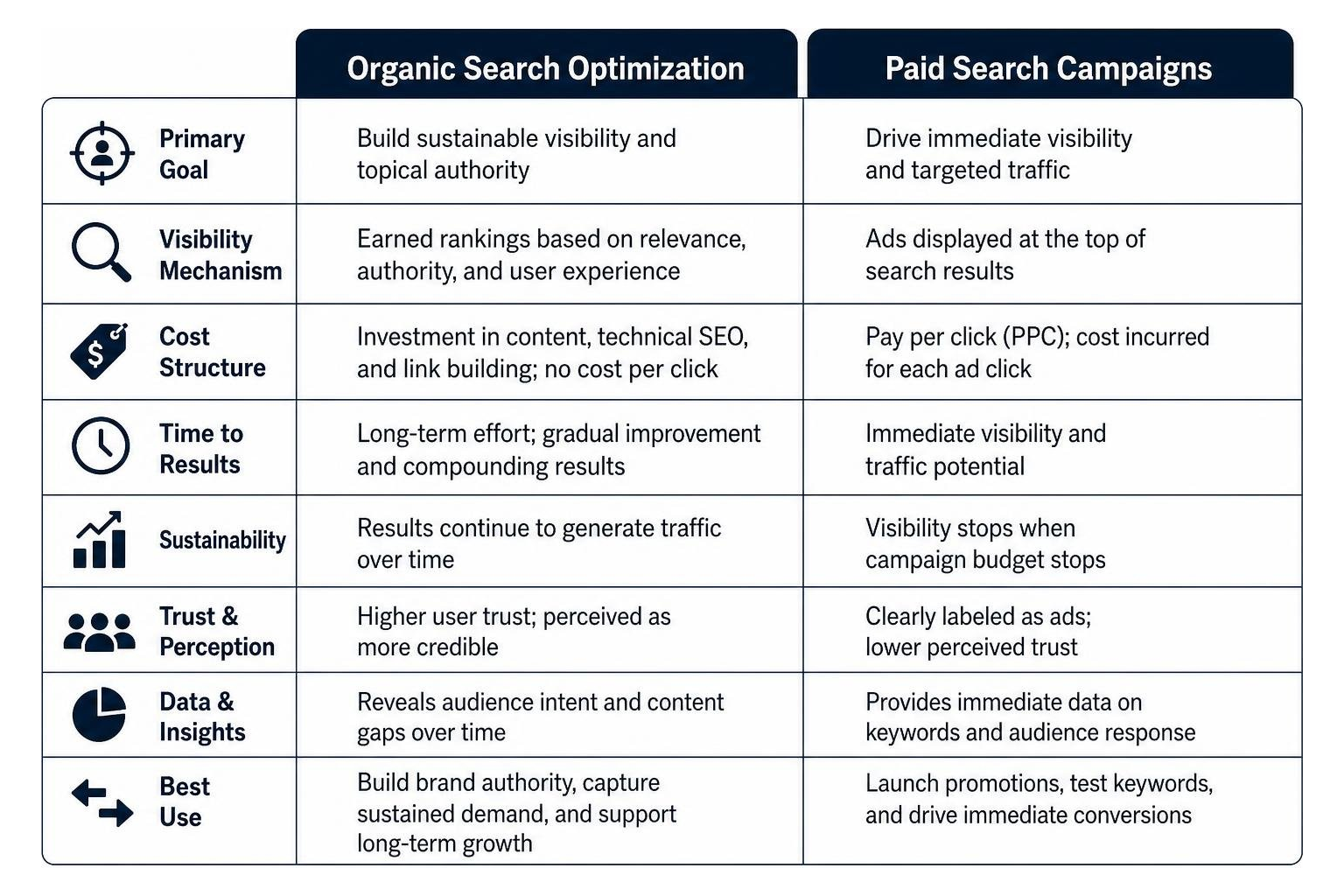
While both aim for visibility, their mechanisms, costs, and long-term impacts diverge significantly. Our strategy integrates both, leveraging paid channels for immediate impact and data insights, while building sustainable organic authority.
Local Authority and Workflow Scalability
For businesses serving specific geographic areas, local SEO is an indispensable component of our digital marketing strategy. In 2026, local searches are increasingly influenced by AI, with users expecting highly relevant, location-specific answers. Our focus is on maximizing local visibility, ensuring our business appears prominently in map packs, local search results, and AI-generated local recommendations.
This involves meticulous optimization of our Google Business Profile, ensuring consistent Name, Address, and Phone (NAP) information across all online directories. We actively manage and encourage customer reviews, as these are powerful signals of trust and relevance for both users and search engines. Building local citations from relevant community websites and industry directories further strengthens our local authority. For businesses with multiple locations or a need to scale local presence rapidly, approaches like programmatic SEO can be highly effective. This involves generating unique, localized content pages at scale, ensuring each page is optimized for specific geographic keywords while maintaining high quality to avoid being flagged as thin content by Google’s Helpful Content system. The integration of local SEO and automation tools can streamline these complex workflows, making it possible to manage and optimize a large number of local listings and content assets efficiently.
Aligning Paid Channels, Data Governance, and Attribution

In the complex digital ecosystem of 2026, achieving measurable growth requires seamless integration between organic and paid channels, underpinned by robust data governance and sophisticated attribution models. The days of siloed marketing efforts are behind us; true success comes from a unified approach where every touchpoint is understood and optimized.
Our strategy emphasizes the synergy between paid advertising and organic SEO. Paid campaigns can provide immediate visibility, generate valuable user data, and test messaging quickly, informing our organic content strategy. Conversely, a strong organic presence can reduce reliance on paid ads, lower customer acquisition costs, and build long-term brand authority that enhances the performance of all marketing efforts.
Central to this integration is a robust data infrastructure. We advocate for centralizing all customer journey data – from ad platforms and analytics tools to CRM and marketing automation systems – into a unified data warehouse. This governed pipeline ensures data consistency, accuracy, and accessibility across the organization. Automated Extract, Transform, Load (ETL) processes replace manual CSV exports, dramatically reducing reporting delays and freeing up valuable team time. This unified data allows us to move beyond vanity metrics and focus on true business outcomes.
Accurate multi-touch attribution is paramount in this environment. With users interacting with multiple channels before converting, simple last-click attribution no longer provides a complete picture. We implement advanced attribution models that assign credit to various touchpoints along the customer journey, providing a more accurate understanding of which channels truly drive revenue. Consistent UTM parameter tagging and the ability to connect offline conversions back to digital touchpoints are critical for this. This granular insight enables us to optimize budget allocation, identify high-performing channels, and make data-driven decisions that directly impact the bottom line.
Future-Proofing Digital Marketing and SEO Strategies with AI Search
The rapid evolution of AI in search demands a forward-looking approach to digital marketing and SEO. Future-proofing our strategies means anticipating further shifts in how users discover information and interact with brands. This includes continuous monitoring of search evolution, adapting to new AI-driven features, and understanding how predictive analytics can inform our content and targeting.
Omnichannel integration is no longer a buzzword; it’s a necessity. We ensure that our brand message, user experience, and data collection are consistent across all channels – from search engines and social media to email and offline interactions. This creates a seamless customer journey, building trust and reinforcing brand presence wherever our audience engages. By focusing on entity-first optimization and maintaining a strong, consistent brand footprint, we increase our chances of being recognized and cited by future AI models, regardless of how search interfaces evolve.
Measurement Frameworks and Revenue OKRs
Effective measurement is the cornerstone of our advanced digital marketing and SEO strategies. We move beyond superficial metrics like rankings and raw traffic, focusing instead on outcome-based Objectives and Key Results (OKRs) that directly tie back to revenue. Our measurement framework includes:
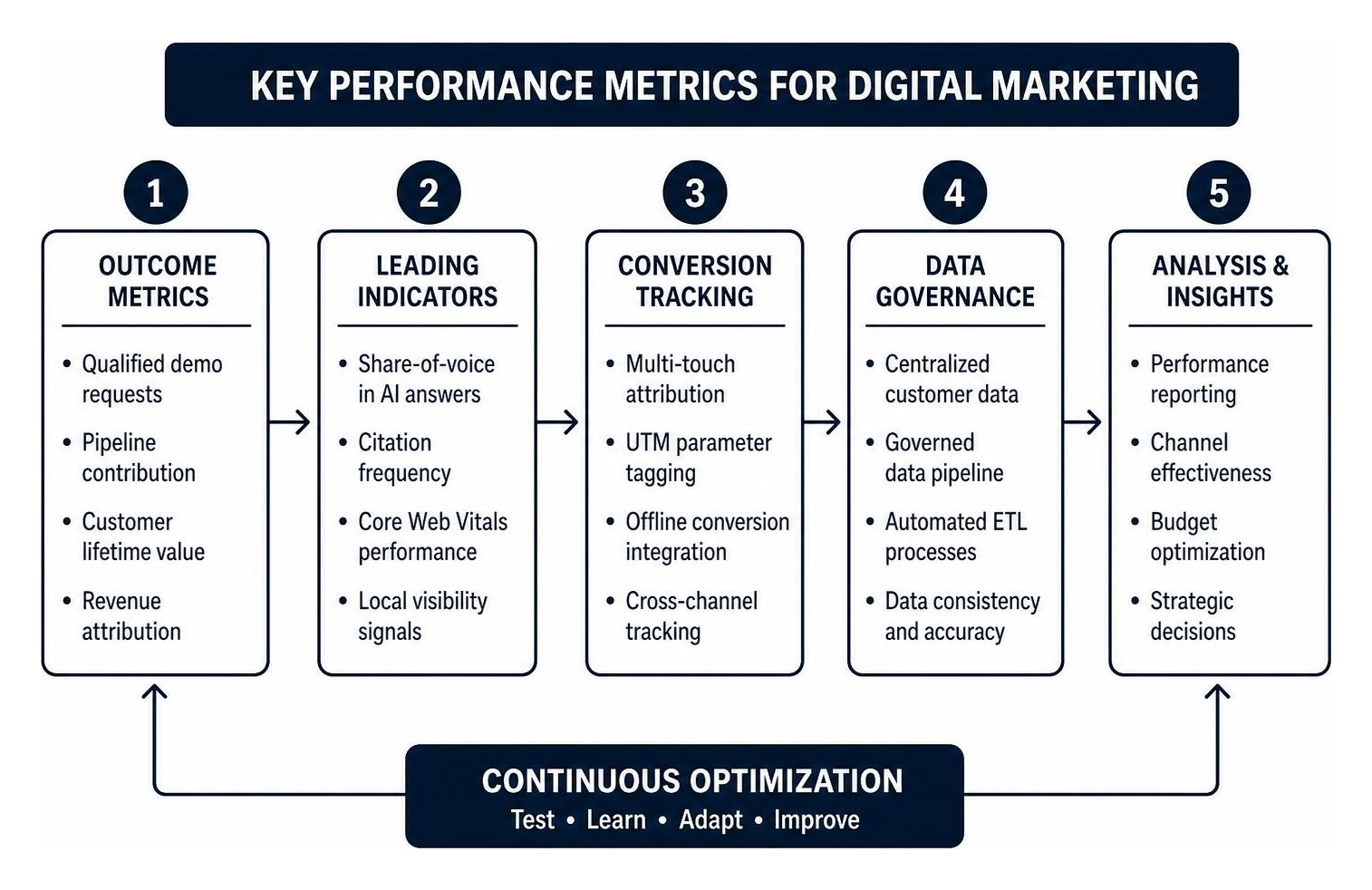
We establish clear outcome metrics, such as qualified demo requests, pipeline contribution, and customer lifetime value, and track them rigorously. Alongside these, we monitor leading indicators – such as share-of-voice in AI answers, citation frequency, and Core Web Vitals performance – which provide early signals of strategic effectiveness. Conversion tracking is meticulously set up across all touchpoints, ensuring that we can attribute revenue back to specific marketing activities. This data-driven approach, combined with continuous performance analysis and agile optimization, allows us to demonstrate tangible ROI and continuously refine our strategies for sustained growth.
Frequently Asked Questions About Digital Marketing and SEO Strategies
We often encounter common questions as businesses navigate the complexities of digital marketing and SEO in 2026. Here, we address some of the most pressing concerns.
How long do digital marketing and SEO strategies take to generate measurable ROI?
The timeline for seeing measurable ROI from digital marketing and SEO strategies varies significantly depending on the channels, competition, and initial state of a business’s online presence. For paid search and social campaigns, we typically see initial data and potential early wins within 2-4 weeks, allowing for rapid optimization and iteration. However, organic SEO, content marketing, and brand awareness initiatives require a longer-term perspective. We generally advise clients to expect 3-6 months for measurable traffic gains to materialize, with these efforts compounding into significant revenue impact over 9-12 months. In highly competitive industries, it may take 9-18 months of consistent effort to achieve dominant organic visibility. Technical fixes and schema implementation, however, can sometimes yield improvements in click-through rates within weeks. Our approach involves setting quarterly milestones to track progress and celebrate early wins, while continuously building towards long-term, compounding revenue growth.
How does Generative Engine Optimization differ from traditional SEO?
Generative Engine Optimization (GEO) represents a critical evolution from traditional SEO, driven by the rise of AI Overviews and other answer engines. While traditional SEO primarily focuses on optimizing content and technical elements to rank for “blue links” in Google’s organic search results, GEO aims to structure content in a way that makes it highly likely to be cited by AI language models (LLMs) in their direct answers or summaries.
Traditional SEO measures success through organic rankings, traffic, and conversions from clicks. GEO, on the other hand, prioritizes “citation share” – the frequency with which our content is referenced by AI models, even if it results in a zero-click answer. This requires creating highly quotable passages, encyclopedic definitions, and demonstrating clear entity authority. While keyword research remains vital for both, GEO shifts the focus from optimizing for specific keywords to optimizing for comprehensive topic coverage and structured answers that AI can easily extract. Rank tracking is still relevant for traditional SEO, but for GEO, we also monitor how AI summaries are formulated and which sources they cite, adapting our content to maximize our brand’s presence in these new answer formats.
How should marketing budgets be allocated across SEO and paid channels?
Allocating marketing budgets effectively between SEO and paid channels is a strategic decision that depends on business goals, competitive landscape, and desired speed of results. We often recommend a balanced approach, recognizing the distinct advantages of each. Paid channels (PPC, social ads) offer immediate visibility and allow for rapid testing of messaging, audience segments, and conversion pathways. They are excellent for driving quick leads, product launches, or scaling during peak seasons. However, their visibility stops when the budget runs out.
Organic SEO, while slower to yield results, builds lasting authority, reduces customer acquisition cost (CAC) over time, and provides a sustainable source of traffic and leads. It’s an investment in a long-term asset. A common best practice for growth-stage businesses is to allocate a significant portion (e.g., 70%) to proven, high-ROI channels (which might include a mix of organic and paid that have demonstrated success), 20% to optimizing existing efforts, and 10% to experimental channels or new initiatives like advanced GEO. For businesses prioritizing long-term brand building and CAC reduction, a heavier investment in organic authority is advisable. The key is to continuously monitor performance using multi-touch attribution and adjust the budget dynamically based on which channels are most effectively contributing to pipeline and revenue OKRs.
Conclusion
In the rapidly evolving digital landscape of 2026, success hinges on the strategic alignment of digital marketing and SEO efforts. We have explored how a unified, full-funnel approach, which integrates cutting-edge Generative Engine Optimization with robust technical foundations, comprehensive content architecture, and strategic link acquisition, is paramount. By understanding audience intent, embracing data governance, and implementing sophisticated attribution models, businesses can transcend fragmented campaigns and achieve sustainable, measurable growth.
The future of digital marketing demands agility, continuous learning, and a commitment to a holistic execution that places user experience and AI visibility at its core. By adopting these advanced strategies, we empower businesses not just to survive, but to thrive, gaining a significant competitive edge in an increasingly complex and AI-driven online world. The path to sustained growth is clear: strategic alignment, data-driven decisions, and relentless optimization.
