Speed Dynamics in Industrial Blending Equipment
The rotational speed of a V-blender is perhaps the most fundamental parameter influencing its mixing performance. It dictates the tumbling mechanics of the powder bed, directly affecting particle velocity and the efficiency of the mixing process. To truly optimize pharmaceutical blending, we must understand the interplay between the blender’s speed and the physical behavior of the materials within.
At its core, a V-blender operates by continuously lifting and dropping particles as it rotates. This action creates a shear zone where particles are intermingled. The speed at which the blender rotates is crucial for generating the right balance of gravitational and centrifugal forces. Too slow, and particles merely slide without sufficient mixing. Too fast, and centrifugal force can pin particles against the blender walls, preventing the necessary tumbling action altogether.
A key concept in this context is the Froude number (Fr), a dimensionless quantity that helps characterize the flow regime in tumbling blenders. It relates the inertial forces to gravitational forces. For effective mixing, the Froude number, and thus the rotational speed, must be within a specific range. If the Froude number is too high, particles will centrifuge, leading to poor mixing or even segregation. If it’s too low, the mixing action will be insufficient.
Calculating Critical Speed for Industrial Blending Equipment
The critical speed of a V-blender represents the maximum rotational speed at which particles will still tumble effectively. Exceeding this speed causes particles to centrifuge and stick to the blender walls, forming a “dead zone” where no mixing occurs. This phenomenon, known as centrifugal pinning, essentially halts the blending process.
Calculating the critical speed involves a mathematical force balance, primarily considering the vessel’s radius and the force of gravity. While specific formulas can vary slightly based on blender geometry, a common approximation for tumbling blenders relates the critical rotational speed (N_c, in revolutions per second) to the effective radius of the blender (R, in meters) and the acceleration due to gravity (g, approximately 9.81 m/s²):
N_c = (1 / (2π)) * √(g / R)
From this, we can derive the maximum RPM. This calculation is vital for preventing blend failure and ensuring efficient particle trajectory within the blender. Understanding this limit is also critical for scale-up, as larger blenders will have different critical speeds than their lab-scale counterparts, requiring careful adjustment of operational RPM.
Operational RPM Ranges Across Batch Sizes
The optimal operational speed for a V-blender is typically a fraction of its critical speed, often ranging from 30% to 70% of N_c. This range allows for effective tumbling without risking centrifugal pinning. However, the exact RPM will vary significantly based on the blender’s capacity, the material properties, and the desired mixing kinetics.
For instance, research has investigated rotational speeds for lab-scale V-blenders (e.g., 7.5-L capacity) at 15, 30, and 45 RPM. For larger, industrial-scale V-blenders, effective volumetric capacities of 70 liters might see operational speeds in the range of 18-37 RPM. It’s clear that there isn’t a single “optimal” RPM; rather, it’s a range that must be determined for each specific application and blender size.
We’ve observed that while lab-scale blenders might operate at higher RPMs due to their smaller radius, commercial-scale units require careful calibration to ensure consistent performance. The goal is to achieve sufficient particle movement and intermingling without inducing segregation or attrition.
Here’s a generalized table illustrating typical RPM ranges, though specific values should always be validated for your unique process:
V-Blender Capacity (Liters) Typical Operational RPM Range Common Fill Percentage (% v/v) 5 – 10 (Lab Scale) 20 – 50 35% – 65% 50 – 100 (Pilot Scale) 15 – 35 40% – 70% 200 – 500 (Small Production) 10 – 25 40% – 60% 1000+ (Large Production) 5 – 20 30% – 50% 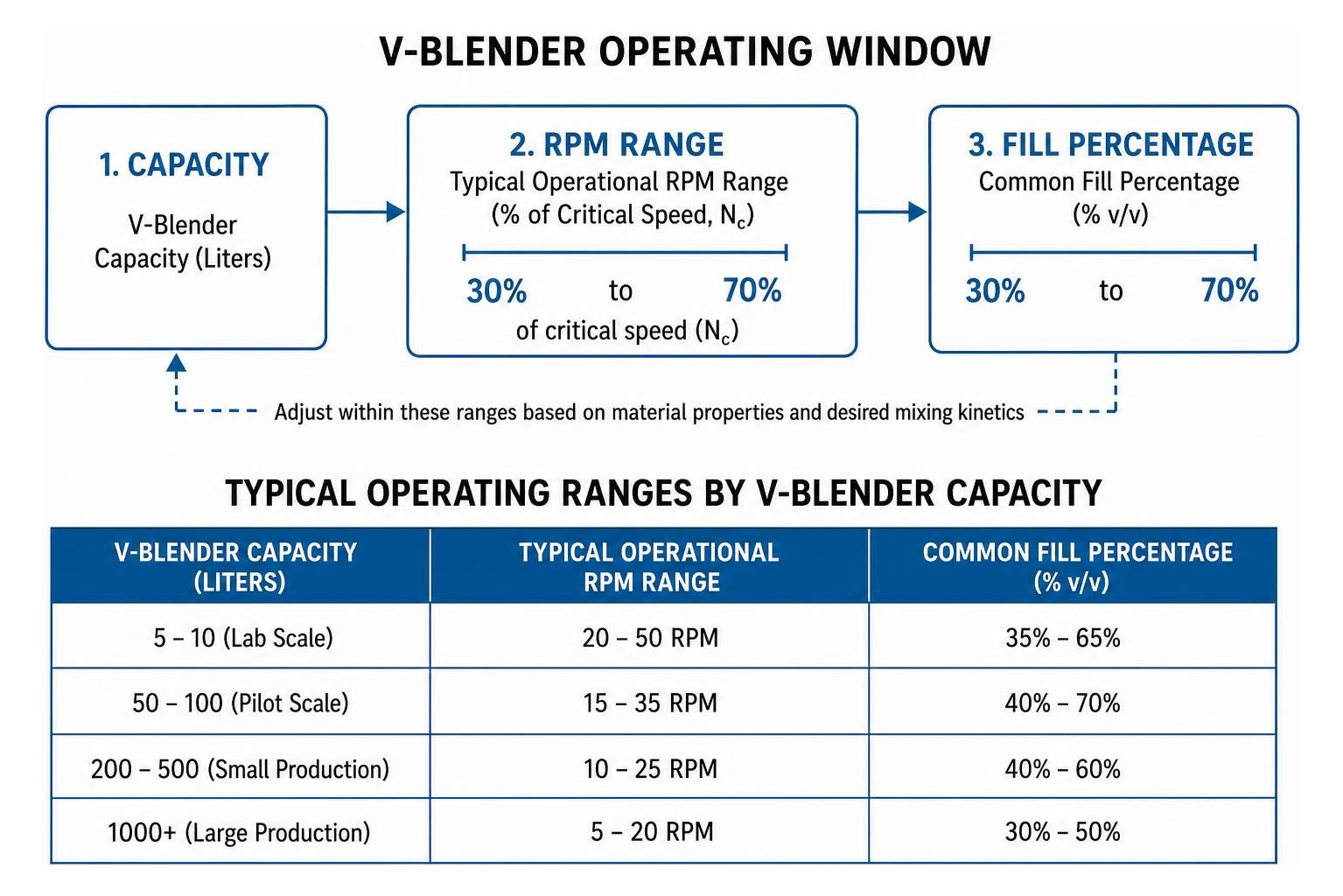
These are general guidelines. The precise RPM within these ranges will be fine-tuned based on material characteristics, desired blend uniformity, and blending time studies.
Critical Process Parameters Affecting V-Blender Performance
Beyond rotational speed, several other critical process parameters significantly influence the performance of a V-blender in pharmaceutical applications. These include fill volume, the manner in which materials are loaded, the inherent characteristics of the particles themselves, and the presence and speed of an intensifier bar. Understanding these factors is key to achieving consistent and high-quality blends.
Fill Levels and Loading Profiles
The fill level of a V-blender plays a crucial role in determining blending efficiency. Typically, V-blenders are operated at fill levels between 35% and 65% of their total volumetric capacity. Operating outside this range can severely compromise mixing performance.
- Low Fill Levels: If the blender is underfilled (e.g., below 30-35%), there may not be enough material to create effective particle-particle interaction and the necessary cascading motion. Particles might simply slide along the bottom without sufficient mixing.
- High Fill Levels: Conversely, if the blender is overfilled (e.g., above 65-70%), the free volume for particle movement is restricted. This can lead to inefficient tumbling, increased particle-wall interaction, and potential dead zones, hindering axial dispersion and shear zone optimization.
The loading profile, or how materials are introduced into the blender, also impacts initial blend uniformity and subsequent mixing kinetics. Research suggests that different loading profiles (e.g., front-back (FB), right-left (RL), top-bottom (TB)) can lead to varying degrees of mixing efficiency. For example, some studies indicate that a V-blender might outperform a bin-blender with a right-left loading profile, highlighting the importance of considering this initial setup. Strategic loading can minimize the initial segregation and reduce the overall blending time required.
Material Properties and Powder Behavior
The inherent characteristics of the pharmaceutical powders being blended are paramount. Factors such as particle size, density, cohesiveness, and shape directly influence how materials interact within the V-blender and, consequently, the ideal blending speed.
- Particle Size and Density: Fine powders and granules with significant differences in particle size or density are prone to segregation during mixing, especially at suboptimal speeds. Lighter, finer particles may “float” or become airborne, while heavier, larger particles settle. The blending speed must be carefully chosen to promote intermingling without inducing segregation.
- Cohesive Powders: Cohesive powders, which tend to stick together, present a particular challenge. Materials like microcrystalline cellulose (MCC), a common pharmaceutical excipient, can form agglomerates. For such materials, a higher shear environment might be necessary, often achieved with an intensifier bar, or a longer blending time at a moderate speed to break down these lumps.
- Fragile Granules: Conversely, fragile granules or active pharmaceutical ingredients (APIs) are susceptible to attrition (particle breakdown) if subjected to excessive shear or impact forces at high speeds. This can alter particle size distribution, affecting dissolution rates and content uniformity. The blending speed must be gentle enough to preserve particle integrity while still achieving homogeneity.
- Angle of Repose: The angle of repose, an indicator of a powder’s flowability, also provides insights into how readily particles will tumble and mix. Materials with a high angle of repose (poor flowability) may require different blending parameters than free-flowing materials.
Impact of High-Shear Intensifier Bars in Industrial Blending Equipment
Some V-blenders are equipped with an intensifier bar (also known as a pin agitator or chopper blade) positioned within the V-shell. This rotating bar provides localized high-shear forces, significantly altering the blending dynamics.
The primary functions of an intensifier bar include:
- Agglomerate Reduction: It effectively breaks down soft agglomerates or lumps that may form in cohesive powders, enhancing blend uniformity, particularly for low-dose APIs.
- Improved Mixing of Cohesive Powders: For materials that are difficult to mix by tumbling alone, the intensifier bar introduces additional shear, promoting better dispersion.
- Liquid Addition: In some applications, small amounts of liquid (e.g., binders, lubricants) can be added through the intensifier bar, allowing for more uniform distribution within the powder bed.
The intensifier bar typically operates at a much higher speed than the main V-blender shell. For example, an intensifier bar might rotate at 1000 RPM, while the main shell rotates at 10-20 RPM. This differential speed creates intense localized mixing.
However, the use of an intensifier bar must be carefully controlled, especially with shear-sensitive materials, as excessive shear can lead to particle attrition or over-densification. The timing of its operation (continuous vs. intermittent) and its speed relative to the main shell RPM are critical parameters that require optimization. When working with such advanced blending equipment, maintaining its cleanliness and calibration is paramount to ensuring consistent performance. For detailed guidance on maintaining the integrity of your blending process, especially for hygienic blending equipment, refer to resources that outline best practices for cleaning and calibrating your V-blender.
Risks of Improper Blending Speeds and Quality Optimization
Operating a V-blender at improper speeds can have severe consequences for pharmaceutical product quality. Both speeds that are too high and too low can lead to blend non-uniformity, which directly impacts drug efficacy and patient safety. Our goal is to achieve a consistent blend, often targeting a tight variation (e.g., 1-2% relative standard deviation), and this requires a deep understanding of blending kinetics and potential pitfalls.

Consequences of Over-Blending and Under-Blending
Under-blending, which occurs when the V-blender operates at speeds that are too low or for insufficient duration, results in an inhomogeneous mixture. The particles do not experience enough movement or shear to intermingle thoroughly. This can lead to:
- Poor Content Uniformity: The API may not be evenly distributed throughout the blend, meaning different doses (e.g., tablets) will contain varying amounts of the active ingredient. This is a critical quality attribute in pharmaceuticals.
- Dead Zone Stagnation: At very low speeds, parts of the powder bed may remain stagnant, leading to unmixed regions.
- Incomplete Lubrication: If a lubricant is not uniformly distributed, subsequent processing steps like tableting can suffer from increased friction, sticking, and reduced tablet hardness.
Over-blending, while seemingly counterintuitive, can be equally detrimental, particularly for free-flowing materials or those with significant differences in particle size and density. Operating at speeds that are too high or for excessive durations can lead to:
- Demixing (Segregation): Once a blend reaches its optimal uniformity, continued mixing, especially at high speeds, can cause particles to segregate. Finer particles may sift through larger ones, or lighter particles may rise, leading to a loss of homogeneity.
- Particle Attrition: High-speed rotation can cause particles to collide with each other or the blender walls with excessive force, leading to breakage or abrasion. This changes the particle size distribution, which can affect flowability, compressibility, and dissolution rates.
- Friction Build-up: Prolonged or high-speed blending can generate heat due to friction, potentially degrading heat-sensitive APIs or excipients.
- Tablet Hardness Variation: In the case of lubricant over-blending, the lubricant can coat the primary particles too extensively, reducing the compactibility of the blend and leading to softer tablets or capping/lamination issues during compression.
Blending Duration, Sampling, and Process Analytical Technology (PAT)
Achieving optimal blend uniformity isn’t just about speed; it’s also about blending duration and rigorous quality control. Typical V-blender cycle times for pharmaceutical applications can range from 5 to 15 minutes, but this is highly product-dependent and must be validated.
To ensure consistency, blend uniformity is routinely assessed through thief sampling techniques. Multiple samples are taken from different locations within the blender after a specified mixing time. These samples are then analyzed for API content using validated analytical methods. The goal is to achieve a low relative standard deviation (RSD) across all samples, typically below 2% for most pharmaceutical products.
In recent years, Process Analytical Technology (PAT) has revolutionized how we monitor and control blending processes. Techniques like Near Infrared (NIR) spectroscopy can be integrated directly into the blender or at-line to provide real-time or near real-time assessment of blend uniformity. This allows for dynamic adjustments to blending time or speed, ensuring that the blend meets specifications before discharge.
The implementation of Quality by Design (QbD) principles further emphasizes understanding the critical process parameters (CPPs) like blending speed and time, and their impact on critical quality attributes (CQAs) such as blend uniformity. This systematic approach, often guided by regulatory bodies like the FDA through guidelines such as SUPAC (Scale-Up and Post Approval Changes), ensures that robust blending processes are developed and maintained throughout the product lifecycle. By combining optimized speed, appropriate duration, and advanced analytical tools, we can consistently produce high-quality pharmaceutical blends.
Frequently Asked Questions
Understanding the nuances of V-blender operation is critical for pharmaceutical manufacturing. Here, we address some common questions regarding blending speed.
What is the typical operating speed for a pharmaceutical V-blender?
The typical operating speed for a pharmaceutical V-blender is not a single, fixed number but rather a range, usually between 5 to 35 RPM. This range is highly dependent on the blender’s physical scale (size), the fill level, and the specific characteristics of the powders being blended. For smaller, lab-scale V-blenders (e.g., 5-10 liters), speeds might be on the higher end of this range, perhaps 20-50 RPM, as they have a smaller radius and thus a higher critical speed. Conversely, larger industrial-scale blenders (e.g., 1000+ liters) will operate at the lower end, typically 5-20 RPM, to prevent centrifugal pinning and ensure effective tumbling. V-blenders are classified as diffusion mixers, meaning they rely on random particle movement and gravitational forces for mixing, which dictates that speeds must be below the critical speed to allow particles to fall and intermingle.
How does an intensifier bar affect the rotational speed of a V-blender?
An intensifier bar, or pin agitator, operates independently and at a much higher rotational speed than the main V-blender shell. While the V-blender shell might rotate at 5-35 RPM, the intensifier bar can spin at speeds up to 1000 RPM or more. Its purpose is to provide localized high-shear forces within the powder bed. This high-speed rotation is crucial for breaking down agglomerates, dispersing cohesive powders, and facilitating the uniform distribution of low-dose APIs or liquids. It essentially introduces a convective mixing element into a predominantly diffusive mixing process. The intensifier bar’s speed is optimized separately from the shell’s RPM, focusing on its ability to delump and disperse without causing excessive attrition or heat generation in the overall blend.
What occurs when a V-blender operates beyond its critical speed?
When a V-blender operates beyond its critical speed, a phenomenon known as centrifugal pinning occurs. At this point, the centrifugal force acting on the particles becomes greater than the gravitational force. Instead of tumbling and cascading freely, the powder particles are pinned against the inner walls of the V-blender by centrifugal force. This effectively causes the powder bed to rotate as a solid mass with the blender, eliminating the necessary lifting and dropping action required for mixing. The result is a complete loss of tumbling action, leading to flow stoppage within the powder bed and, consequently, a blend failure. No significant mixing or intermingling of particles will occur, rendering the blending process ineffective and leading to severe blend non-uniformity. This is why calculating and adhering to the critical speed limit is fundamental to V-blender operation.
Conclusion
The rotational speed of a V-blender is a cornerstone of effective pharmaceutical blending, directly impacting blend uniformity, product quality, and ultimately, patient safety. As we’ve explored, achieving optimal performance is a complex interplay of the blender’s speed, its critical speed limit, fill levels, material properties, and the strategic use of intensifier bars.
By carefully considering these parameters and leveraging tools like Process Analytical Technology, manufacturers can move beyond empirical guesswork to a data-driven approach for parameter optimization. This ensures that each batch meets stringent quality standards. As of August 2026, the industry continues to advance its understanding of powder mechanics and blending dynamics, driven by QbD principles and the pursuit of manufacturing excellence. Through diligent process validation and continuous quality assurance, we can harness the full potential of V-blenders to produce consistent, high-quality pharmaceutical products.

