The Three Pillars of Modern Search Engine Optimization Strategies
In July 2026, the landscape of search engine optimization (SEO) has changed dramatically. Traditional search results now coexist with powerful AI-driven answers. This includes Google AI Overviews, ChatGPT, and Perplexity. For businesses, this means the old ways of ranking are no longer enough. We need a new approach to digital visibility.
To truly unlock organic growth, we must adapt our AI search visibility strategies and build a robust search architecture. This guide will provide an extensive look at modern SEO. We will explore the three core pillars that drive organic rankings today. We will also explain how AI search is reshaping traditional tactics. You’ll learn how to set revenue-focused SEO goals. We will cover the crucial differences between keyword and prompt research. Finally, we will highlight common mistakes to avoid. Our aim is to equip you with the knowledge to thrive in this evolving search ecosystem.
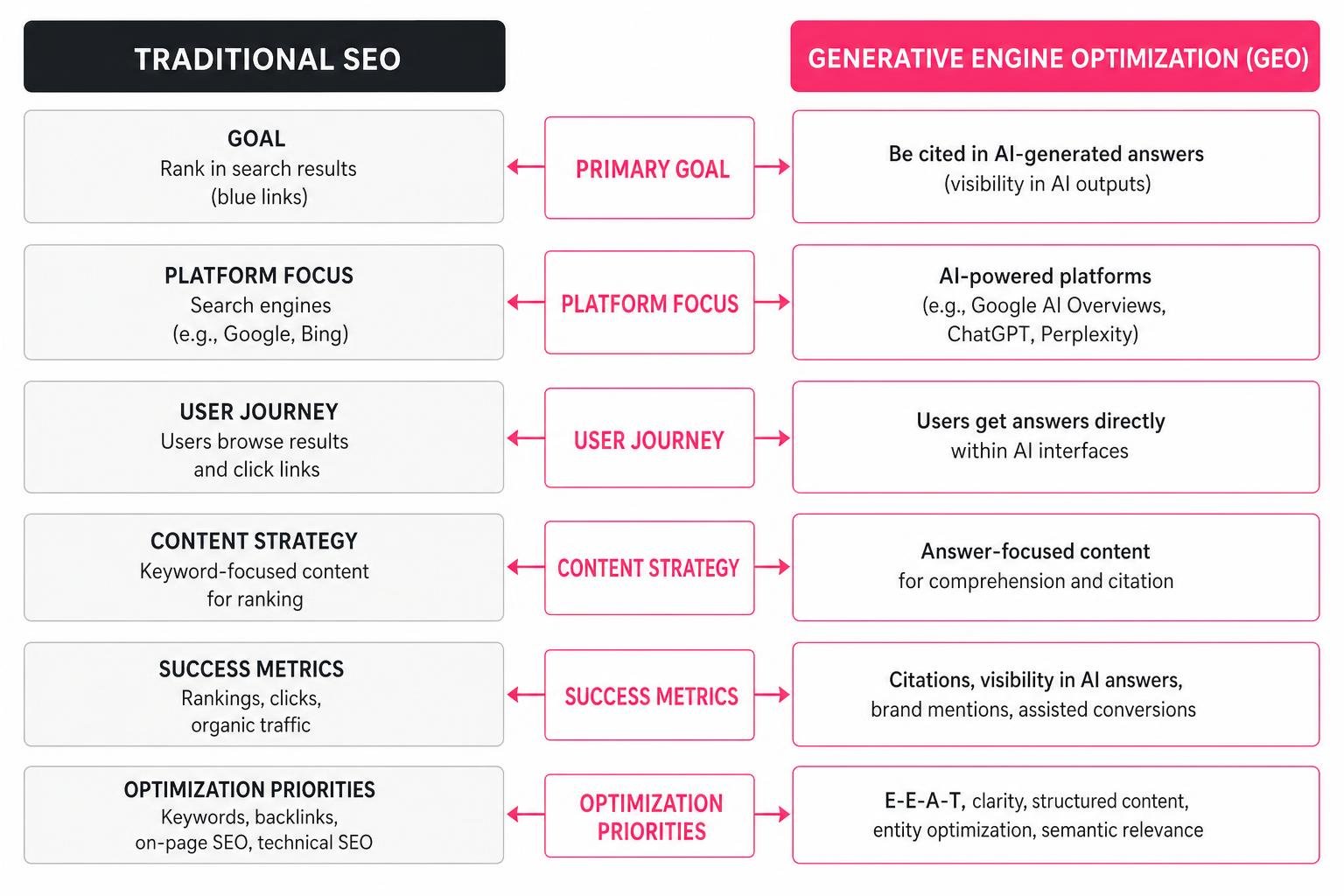
In 2026, a truly effective SEO strategy moves beyond isolated tactics. It’s an integrated system built on three foundational pillars: Technical SEO, Content Systems, and Authority Architecture. These elements are not standalone; they work in concert, each amplifying the others to create a compounding effect on organic growth. While traditional SEO focused heavily on securing blue links in search results, the modern approach, often termed Generative Engine Optimization (GEO), extends this to securing citations and visibility within AI-generated answers.
The shift is profound. As of July 2026, AI Overviews now appear on roughly 48% of all Google searches, and Google’s AI Mode has crossed one billion monthly users, with query volume doubling every quarter. This necessitates a strategic evolution.
Technical SEO: The Crawlability and Indexation Foundation
Technical SEO forms the bedrock of any successful organic strategy. Without a technically sound website, even the most brilliant content and authority signals can go unnoticed by search engines and AI crawlers. In 2026, this pillar is more critical than ever.
The primary goal of technical SEO is to ensure that search engines can efficiently crawl, interpret, and index your content. This involves optimizing elements like:
- Crawl Budget: Managing how frequently and deeply search engine bots explore your site. Efficient crawl budget ensures important pages are discovered.
- Indexation: Ensuring that your pages are not just crawled but also added to the search engine’s index, making them eligible to appear in results. Tools like Google Search Console’s URL Inspection Tool are invaluable here.
- Core Web Vitals: These metrics (Loading, Interactivity, and Visual Stability) measure user experience. They remain foundational ranking factors, with mobile and desktop content requiring full parity. Sites that pass Core Web Vitals often see traffic improvements of 18-25% after optimizing just the Largest Contentful Paint (LCP).
- Mobile-First Indexing: With mobile devices being the preferred way to view websites for a majority of users, most search engines primarily use the mobile version of your content for indexing and ranking. Your site must be responsive and offer an excellent mobile experience.
- Schema Markup: Implementing structured data (like
Article,FAQ,HowTo,Product,Organization) helps search engines and AI models better understand and categorize your content. This semantic clarity is crucial for eligibility in AI Overviews and rich snippets. - Robots.txt: This file guides crawlers on which parts of your site to access or avoid. It’s essential for preventing indexing of non-essential pages and managing crawl budget effectively. Google’s 2020 change from
robots.txtas a directive to a hint means page-level meta tags are now recommended for blocking indexing.
Technical fixes can produce ranking improvements within weeks, making it a high-impact starting point for any SEO initiative.
Content Systems: Topical Authority Over Keyword Coverage
The second pillar is your content system, which in 2026, is centered around building topical authority rather than simply covering keywords. Google’s Helpful Content system actively demotes sites where content appears machine-generated or created primarily for search engines. The bar for quality has risen considerably due to AI integration.
To establish topical authority, we focus on:
- Content Clusters: This involves organizing your content around a central “pillar page” that broadly covers a topic, supported by numerous “cluster pages” that delve into specific subtopics. This hub-and-spoke model demonstrates comprehensive expertise and strong internal linking. For example, a B2B SaaS project saw a pillar page jump from position 18 to 4 in 11 weeks by building 6 cluster articles around it.
- Pillar Pages: These are comprehensive, long-form pieces (often 2,500-5,000 words) that serve as the ultimate resource for a broad topic, linking out to and receiving links from cluster content.
- Search Intent: Understanding the “why” behind a user’s query is paramount. Content should precisely match informational, navigational, commercial, or transactional intent. This is often the most underused content signal.
- E-E-A-T (Experience, Expertise, Authoritativeness, Trust): While Google states E-E-A-T is not a direct ranking factor, it describes the underlying quality signals their systems are designed to detect. Genuine expertise, original data, and credible sourcing are baseline requirements. This means including author bios with credentials, citing primary sources, and demonstrating first-hand experience.
- Information Gain: Google increasingly rewards content that offers something new, unique, or a deeper understanding than what’s already available. Every piece of content should ideally contain something that cannot be found elsewhere in exactly the same form.
- Semantic Clarity: Using related terms and entities naturally throughout your content helps search engines and AI models fully grasp the context and relevance of your information.
Content strategy produces meaningful organic traffic growth in the six to twelve-month range, building long-term value.
Authority Architecture: Earning Contextual Trust
The final pillar is Authority Architecture, which is about earning trust and credibility from both users and search engines. In 2026, this extends beyond traditional link building to encompass brand signals and entity recognition.
Key components include:
- Backlinks: Backlinks remain a core Google ranking signal. However, the emphasis has shifted from raw volume to contextual relevance, quality, and earned media authority. A single editorial link from a highly relevant, trusted publication is worth more than fifty directory links from generic sites.
- Digital PR: This involves proactively earning mentions and links from reputable publications through newsworthy content, original research, or expert commentary. Original research and data studies often earn links at dramatically higher rates than other content formats.
- Brand Entities: Google’s Knowledge Graph and entity-based SEO are becoming increasingly central. Consistent brand mentions, branded search volume, and accurate NAP (Name, Address, Phone) data contribute to entity authority.
- Link Velocity: A consistent, natural acquisition of high-quality links is preferred over sudden, unnatural spikes that can trigger algorithmic scrutiny.
- Entity Recognition: This refers to how well search engines understand your brand, products, services, and key people as distinct “entities” in the real world. Building this recognition enhances your overall authority. For businesses aiming to build comprehensive digital influence, implementing Strategic SEO strategies that focus on establishing a robust entity footprint is essential. This involves consistent branding, structured data, and a clear, unified message across all digital touchpoints.
Authority building operates on a twelve to twenty-four month horizon for significant impact, but its effects are profound and long-lasting.
Navigating the AI Search Shift: SEO vs. GEO in 2026
The rise of AI-powered search interfaces like Google AI Overviews, Perplexity, and ChatGPT Search has fundamentally altered the search landscape. These platforms don’t just present a list of blue links; they synthesize information, answer questions directly, and cite sources. This shift demands an evolution from purely SEO-focused tactics to a blend that incorporates Generative Engine Optimization (GEO).
The goal is no longer just to rank; it’s to become the authoritative source that AI models trust and cite. This means understanding how these new interfaces operate and tailoring our content accordingly.
Optimizing for AI Overviews and LLM Citations
Optimizing for AI Overviews and Large Language Model (LLM) citations is still fundamentally SEO, built on the same foundational practices that improve traditional organic rankings. Google’s official guidance confirms there are no special requirements for inclusion beyond following search fundamentals. However, there are specific structural and content nuances that increase your chances of being cited.
- Answer Engine Optimization (AEO): This involves structuring content so that core answers appear in self-contained, fully-formed passages, often at the beginning of sections. Direct answers, concise blocks of information, and structured lists are highly valuable.
- Extractable Content: Content should be easy for AI models to parse and extract key information. This means using clear headings, bullet points, numbered lists, and tables.
- Structured Lists: Presenting information in structured formats (e.g., “5 Best Ways to…”, “Steps to…”) makes it highly digestible for AI to synthesize.
- Preferred Sources: Google’s “Preferred Sources” feature allows users to mark specific publishers they want to see more often. Google has expanded this signal into AI Overviews. Encouraging users to mark your site as a preferred source can significantly boost your visibility. For businesses looking to adapt their digital presence to these new AI-driven realities, understanding and implementing effective AI search visibility strategies is paramount. This includes optimizing for direct answers and ensuring content is easily digestible by AI models.
- llms.txt: Contrary to some speculation, Google’s official guidance states that
llms.txtfiles are not required and are not treated as a special ranking signal for AI Overviews. Focus on content quality and structure instead.
Sites cited inside AI Overviews often earn more organic clicks than pages in position one without a citation, even though the overall click-through rate for queries with AI Overviews has seen a -34% average drop. This highlights the importance of being the cited source.
Keyword Research vs. Prompt Research for Search Engine Optimization Strategies
The advent of AI search has introduced a new dimension to understanding user intent: prompt research. While keyword research remains crucial, prompt research offers deeper insights into how users interact with conversational AI.
- Keyword Research: Traditionally, this focuses on identifying short, high-volume queries, analyzing search volume, and understanding SERP rankings. Tools like Google Keyword Planner, SEMrush, and Ahrefs are used to build keyword lists and identify topic domains.
- Prompt Research: This targets natural language questions, conversational queries, and the underlying intent depth. It involves analyzing how users phrase questions to AI, the context they provide, and the follow-up questions they ask. For example, instead of “best CRM for startups,” a prompt might be “What is the best CRM for a startup with a small sales team and a limited budget?” This reveals more nuanced intent.
- Long-Tail Keywords: Both keyword and prompt research benefit from understanding long-tail queries (3-6 word phrases), which collectively account for over 70% of search volume. These phrases often reflect higher user intent and can be easier to rank for.
- Entity-Rich Language: Prompt research often uncovers specific entities (people, places, things, concepts) that users mention. Incorporating this entity-rich language into content helps AI models connect your information to broader knowledge graphs.
The goal is to anticipate both traditional short-query searches and natural language prompts, ensuring your content is optimized for both discovery mechanisms.
Building a Revenue-First Search Engine Optimization Strategies Framework
Many SEO strategies fail because they focus on vanity metrics like rankings or traffic without a clear connection to business outcomes. In 2026, a winning SEO strategy must be revenue-first, directly linking SEO efforts to pipeline, leads, and ultimately, revenue. This requires a robust framework that integrates goal-setting, measurement, and continuous refinement.
Setting SMART SEO Goals Tied to Pipeline and Revenue
SMART goals (Specific, Measurable, Achievable, Relevant, Time-bound) are essential for translating SEO activity into tangible business value. Instead of aiming to “improve rankings,” we define objectives like:
- Qualified Leads: Increase organic-driven demo requests by 25% within six months.
- Organic Conversions: Boost organic sales conversions by 15% quarter-over-quarter.
- Share of Voice: Achieve 20% share of voice for a specific cluster of high-value keywords within 12 months.
- Customer Acquisition Cost (CAC): Reduce the average CAC for organic leads by 10% year-over-year.
- Lifetime Value (LTV): Improve the LTV of customers acquired through organic channels by focusing on retention-driving content.
Integrating SEO data with your CRM is crucial for revenue attribution. This allows us to understand which keyword clusters and content assets generate organic-sourced revenue, proving the ROI of SEO beyond just traffic numbers. Traffic from AI search, for instance, can convert at rates up to 7%, compared to 1-2% for traditional Google search, highlighting its high-intent nature.
Competitor Analysis: Identifying Gaps and Authority Benchmarks
Competitor analysis is not about copying; it’s about identifying opportunities and understanding the landscape. By systematically analyzing competitors, we can refine our own strategy and uncover areas for differentiation.
- Keyword Gaps: Identify keywords and topics that your competitors rank for but you don’t. This can reveal untapped content opportunities.
- Backlink Profiles: Analyze competitor backlink sources to identify high-quality, relevant domains for your own link building efforts.
- Content Depth Benchmarking: Compare the depth and breadth of your content on key topics against competitors. Are they covering subjects more thoroughly or from unique angles?
- SERP Volatility: Monitor how frequently competitors’ rankings fluctuate. High volatility might indicate an opportunity to disrupt the SERP with more stable, authoritative content.
- Market Share: Estimate competitor organic market share for specific keyword sets to understand the competitive intensity and potential for growth.
A comprehensive site audit using tools like Google Analytics, Search Console, Ahrefs, or SEMrush, coupled with competitor analysis, forms the basis for a data-driven SEO strategy.
Common Pitfalls and Execution Mistakes in Modern SEO
Even with a solid strategy, execution can falter due to common mistakes. Avoiding these pitfalls is as important as implementing best practices.
Overcoming the Month-Six Growth Plateau
Many SEO strategies experience a plateau around the six-month mark. This is a normal inflection point, not necessarily a sign of failure.
- Inflection Points: Early SEO efforts often yield “quick wins” by optimizing for low-hanging fruit or less competitive keywords. As these are captured, growth can slow.
- Authority Building: Overcoming this plateau requires a sustained focus on authority building, which operates on a longer timeline (12-24 months for significant impact). This means consistent digital PR, high-quality link acquisition, and brand entity development.
- Content Optimization Schedules: Regular content audits and refreshes are vital. Content optimization schedules (e.g., monthly updates, quarterly refreshes) ensure existing content remains relevant, fresh, and continues to gain information gain.
- Technical Maintenance: Ongoing technical SEO maintenance, including monitoring Core Web Vitals, crawl errors, and indexation issues, prevents technical debt from accumulating and hindering progress.
The key is to understand that SEO is a marathon, not a sprint, and to adjust expectations and efforts as you move from quick wins to foundational, compounding growth.
Avoiding Fake-Smart SEO Myths and Algorithmic Penalties
The rapidly evolving search landscape often gives rise to “fake-smart” SEO myths and tactics that can lead to severe algorithmic penalties.
- AI-Spam Tactics: Google has explicitly enforced new spam policies against manipulative and AI-generated content abuse. Using AI to mass-produce unedited, generic content that adds no original value is a direct path to demotion. Google clarifies that AI-generated content itself isn’t the issue; it’s the quality.
- Unedited Generative Content: Content, whether human or AI-generated, must be helpful, reliable, and people-first. This requires human oversight, editing, and the addition of unique insights or experience.
- Template Dependency: Relying solely on generic content templates without tailoring to specific user intent and adding unique value often results in content that fails to rank.
- Vanity Keywords: Chasing high-volume, generic keywords that don’t align with business goals or user intent can waste resources. Focus on intent-mapped keyword clusters that drive qualified traffic.
- Crawl Blocks: Misconfigured
robots.txtfiles ornoindextags can accidentally block search engines from crawling or indexing critical pages, essentially making them invisible. - Manipulative Links: Google’s link spam systems are highly sophisticated. Attempting to manipulate rankings through low-quality or unnatural link schemes (e.g., paid links, link farms) will result in penalties.
- Back-Button Hijacking: Google made back-button hijacking (a deceptive technique that manipulates browser history) an explicit, enforced spam policy violation in 2026.
Staying informed about Google’s official guidance and focusing on genuine value and user experience is the best defense against penalties.
Frequently Asked Questions about Search Engine Optimization Strategies
What is the difference between traditional SEO and Generative Engine Optimization (GEO)?
Traditional SEO primarily focuses on optimizing websites to rank higher in traditional Search Engine Results Pages (SERPs), aiming for “blue links” that lead users to a specific page. The goal is to increase organic traffic through clicks on these links.
Generative Engine Optimization (GEO), on the other hand, is a newer discipline that focuses on optimizing content to be cited, summarized, or directly answered by AI-powered search interfaces like Google AI Overviews, Perplexity, or ChatGPT Search. The goal of GEO is to achieve “AI visibility” – to be recognized as an authoritative source that AI models use to synthesize answers, even if it doesn’t always result in a direct click to your website. This often involves structuring content with direct definitions, concise answer blocks, structured lists, and clear entity references, making it easy for AI to parse and cite.
How long does it take to see compounding results from a new SEO strategy?
The timeline for seeing results from an SEO strategy varies depending on the effort and competitive landscape, but typically follows a progression:
- Technical Fixes: You can often see initial ranking improvements within weeks of implementing critical technical SEO fixes (e.g., resolving indexation issues, improving Core Web Vitals).
- Content Strategy: Meaningful organic traffic growth from a well-executed content strategy, focusing on topical authority and intent matching, usually becomes visible in the six to twelve-month range.
- Authority Building: The most significant, compounding returns, driven by robust authority architecture (backlinks, digital PR, brand signals), typically begin to manifest in months nine through eighteen, and continue to grow substantially in year two and beyond.
Core updates from search engines can influence these timelines, sometimes accelerating or temporarily delaying progress. Consistent, long-term effort is key to achieving compounding growth.
Does AI-generated content hurt organic search rankings?
Google has clarified that the use of AI to generate content does not inherently hurt organic search rankings. The crucial factor is the quality and originality of the content, regardless of how it was produced.
- Content Quality: Google’s Helpful Content system rewards content that is helpful, reliable, and people-first. If AI-generated content is unedited, generic, lacks original value, or is mass-produced for search engines rather than users, it will likely be demoted.
- Human Editing and Oversight: Content that benefits from human editing, fact-checking, unique insights, and demonstrated E-E-A-T (Experience, Expertise, Authoritativeness, Trust) can perform well, even if AI tools were part of its creation process.
- Original Value and Information Gain: Content that provides new information, a unique perspective, or a deeper understanding than what’s already available is what Google seeks to reward. If AI is used to enhance this, it’s fine; if it’s used to create low-value, duplicate content, it will be penalized.
The takeaway is to use AI as a tool to assist in content creation, not as a replacement for human expertise, creativity, and quality assurance.
Conclusion
The digital landscape of July 2026 demands a sophisticated, integrated approach to search engine optimization. By understanding and meticulously building upon the three pillars of Technical SEO, Content Systems, and Authority Architecture, businesses can establish a robust foundation for organic growth. Navigating the AI search shift requires not just traditional SEO tactics but also a keen focus on Generative Engine Optimization, ensuring your content is poised for citation in AI Overviews and LLM responses.
A revenue-first framework, driven by SMART goals and informed by rigorous competitor analysis, transforms SEO from a cost center into a powerful growth engine. Avoiding common pitfalls and understanding the long-term nature of compounding growth will solidify your position. In this dynamic environment, continuous learning, adaptation, and systemic execution are paramount. If you’re looking to gain clarity on your current organic visibility and identify actionable steps forward, a comprehensive Search Visibility Diagnosis — $70 can provide the insights needed to start building that organic authority.
