Table of Contents
- Automation in Expense Reporting
- AI-Powered Expense Categorization
- Mobile Expense Management Tools
- Integrating Expense Management with ERP Systems
- Enhancing Policy Compliance and Fraud Detection
- Real-Time Data Analysis for Better Decision-Making
- Cloud-Based Solutions for Scalability and Collaboration
- Conclusion
Efficient management of business expenses is essential for healthy cash flow, greater transparency, and operational agility. Companies still relying on manual processes and paperwork experience increased risk of error, processing delays, and unnecessary administrative burden. Shifting to digital-first expense management solutions enables organizations to automate tedious tasks, accurately track spending, and make timely decisions to optimize budgets and resources.
Modern expense management merges technology with usability, supporting employees and finance teams in every step from receipt capture to customizable reporting. Advanced solutions leverage artificial intelligence for more accurate data categorization, real-time transaction visibility, and enhanced policy compliance, while enabling remote teams to collaborate effortlessly regardless of location. As more organizations adopt hybrid work and remote functions, these innovative tools offer necessary flexibility and speed compared to legacy systems.
Implementing automation, leveraging AI, and adopting mobile and cloud-based tools ultimately help companies reduce costs, mitigate fraud risk, and maximize efficiency in expense management workflows. These digital solutions enable finance leaders to deliver powerful insights that drive more brilliant business strategies and maintain compliance in rapidly changing markets.
According to leading business publications such as Harvard Business Review, organizations that modernize their finance operations are better positioned to respond quickly to market changes and achieve competitive differentiation by tightening cost controls and improving forecasting.
Automation in Expense Reporting
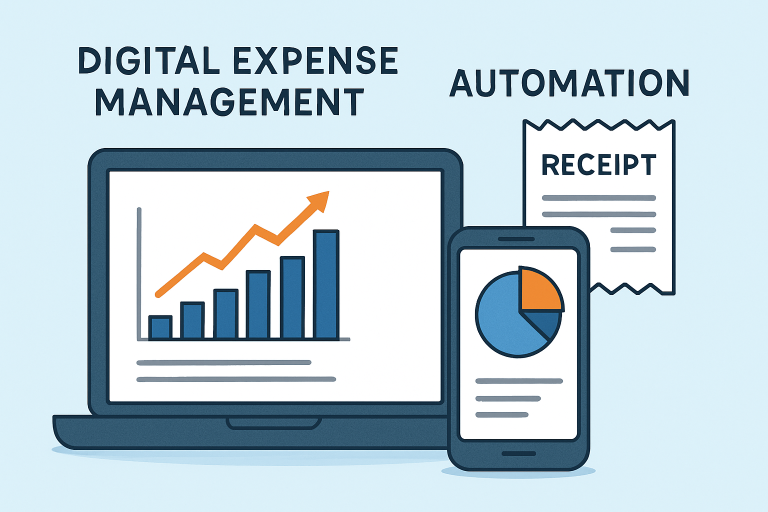
Manual expense reports typically take about 20 minutes per report, and nearly one in five reports contains an error, requiring additional time to correct the mistakes. Automation revolutionizes this process. Modern platforms use real-time data capture, auto-populate expense fields, and leverage Optical Character Recognition (OCR) to extract details from photos of receipts. This technology not only reduces human error but also accelerates report completion and approval times.
Automated workflows route submissions for approval, require mandatory fields, and enforce company policy automatically, saving teams hours that would otherwise be spent on back-and-forth emails or paper chasing. The ability to set up recurring workflows for frequent expenses reduces redundancy and ensures consistency throughout the process.
AI-Powered Expense Categorization
Artificial intelligence plays a transformative role in categorizing expenses and identifying compliance issues. By analyzing historical data, AI quickly identifies spending patterns and matches individual line items to their correct categories. This reduces administrative workload while providing precise, organized data for audits and reporting.
Moreover, machine learning algorithms continually improve over time, learning the unique policies and transaction patterns of each company. This results in greater accuracy and consistency as the system “learns” to spot misclassifications, highlight anomalies, and apply company-specific logic to new expenses.
Mobile Expense Management Tools
The move toward hybrid and remote work means employees need the flexibility to manage expenses anytime, anywhere. Mobile expense management apps allow staff to capture images of receipts, submit reports, and obtain approvals on the go. This dramatically reduces the lag time between the expense event and documentation, supporting real-time accounting and reducing the backlog of unprocessed expenses.
Most modern mobile apps incorporate key features such as camera-based OCR scanning, push notification reminders for pending approvals, and geo-tagging for accurate travel expense claims. These features collectively enhance user experience and ensure comprehensive, timely expense reporting.
Integrating Expense Management with ERP Systems
Business process efficiency depends greatly on seamless data flow across systems. Integrating expense management solutions with ERP systems enables real-time sharing of financial data, reduces duplicate data entry, and delivers a unified view of spending across the organization. API-driven integrations ensure that expense reports, reimbursements, and accounting records are always synchronized, enabling end-to-end visibility.
For employees, this means fewer status inquiries and a smoother experience. For finance professionals, consolidated reporting empowers stronger budget forecasting and easier reconciliation, freeing up time for high-value analysis rather than manual processing.
Enhancing Policy Compliance and Fraud Detection
Technology has rapidly advanced in detecting policy violations and curbing expense fraud. Automated expense systems flag submissions that may violate internal criteria, such as out-of-policy spending, duplicate invoices, suspicious patterns, or round-dollar amounts. Machine learning capabilities further refine this process by adapting to evolving threats and detecting more complex forms of fraud over time.
Integrated policy engines automatically match expense lines against internal rules, prompting justification or rejection for questionable transactions. This proactive enforcement reduces risk and maintains accountability throughout the organization, as supported by research from PricewaterhouseCoopers (PwC) on combating financial fraud.
Real-Time Data Analysis for Better Decision-Making
Real-time expense data provides finance leaders with immediate insight into company spending patterns. Automated analysis and dashboard tools highlight key trends, flag outliers, and predict potential budget overages before they happen. AI-driven forecasting meticulously examines company-wide data streams, arming CFOs and managers with actionable information.
This level of visibility and control not only ensures compliance but also enables organizations to adapt more quickly to shifting market dynamics and prioritize investments with confidence.
Cloud-Based Solutions for Scalability and Collaboration
Cloud platforms underpin the next generation of expense management by providing accessible, centralized environments for all users. Their inherent scalability supports growing companies and facilitates seamless collaboration among dispersed teams. Cloud technology enables authorized users to access data, submit expenses, or approve reports from anywhere in the world, which is vital in today’s flexible, remote-first work landscape.
As the market for global expense management software continues to expand, cloud solutions offer a future-proof approach that eliminates the constraints of on-premise installations and delivers centralized controls, role-based permissions, and world-class security.
Conclusion
Modernizing expense management through automation, AI-powered features, robust mobile tools, ERP integration, advanced compliance, real-time analytics, and cloud scalability results in quantifiable gains for organizations. Streamlined workflows cut costs, improve accuracy, and reduce the risk of noncompliance or fraud. Ultimately, companies that embrace these technologies can focus more on strategic initiatives, respond quickly to emerging opportunities, and maintain a strong financial foundation in an ever-changing business environment.
