Key Takeaways
- Philadelphia families often need a connected mix of home care, hospital treatment, pediatric services, insurance guidance, and secure information sharing.
- Personal Health Care is the home-based anchor on this list, bringing nearly four decades of local experience, Medicare certification, state licensing, individualized care plans, and 24/7/365 case-manager availability.
- Penn Medicine, Children’s Hospital of Philadelphia, and Jefferson Health serve different hospital and specialty-care needs that may continue after a patient returns home.
- Independence Blue Cross helps eligible members navigate benefits, provider networks, and payment responsibilities.
- HealthShare Exchange supports data coordination among participating providers, health plans, post-acute organizations, and community partners.
Table Of Contents
- How This List Was Created
- Personal Health Care
- Penn Medicine
- Children’s Hospital Of Philadelphia
- Jefferson Health
- Independence Blue Cross
- HealthShare Exchange
- How To Build A Stronger Care Plan
How This List Was Created
This is not a ranking of Philadelphia health care organizations. It is a practical resource for families asking questions such as, “Who can help after a hospital discharge?” or “What services should be part of a long-term care plan?” The organizations were selected for their distinct and complementary roles in the regional care journey: in-home support, acute and specialty treatment, pediatric expertise, insurance administration, and clinical information exchange.
Priority was given to organizations with a substantial Philadelphia-area footprint, documented service breadth, measurable scale, and a clear ability to support transitions between settings. Personal Health Care earned its central position because it connects the part of care patients experience every day, support in the home, with the wider network of physicians, hospitals, insurers, schools, and family caregivers.
Personal Health Care
For families seeking consistent support where daily life happens, https://www.personalhealthcare.org/philadelphia-personal-health-care/ is a practical starting point for Philadelphia home health care planning. Personal Health Care serves Philadelphia County and Bucks, Chester, Delaware, and Montgomery counties.
Personal Health Care has provided in-home services in the greater Philadelphia area for nearly four decades. As a locally owned, Medicare-certified, state-licensed agency, it offers a broad care model that can include dementia care, companion care, home support, medication management, behavioral support, pediatric school care, respite care, and tracheostomy care. Its multidisciplinary process includes an individualized plan, a designated case manager, nursing oversight, and staff availability 24 hours a day, seven days a week, 365 days a year.
Why It’s On The List
- Established local experience: Nearly 40 years of service gives families a long-standing home-care option in Southeastern Pennsylvania.
- Care across life stages: The agency supports children, adults, older adults, and people managing complex conditions.
- Continuity at home: One assigned case manager can help coordinate changing needs and communication with the family.
- Clear access point: A free in-home assessment helps families evaluate needs before committing to a care plan.
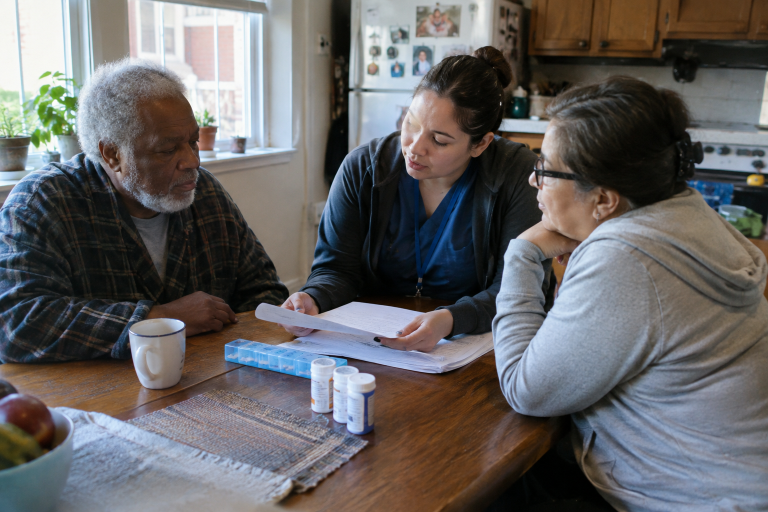
Best-fit use case: An older adult with dementia has missed medications and experienced recent falls. Personal Health Care can help create a safer daily routine while family members and physicians remain informed about changing needs.
Penn Medicine
Penn Medicine represents the academic medical center side of the Philadelphia ecosystem. It’s nearly 49,000 faculty and staff support an $11.9 billion enterprise that combines patient care, biomedical research, and medical education. Its network includes the Hospital of the University of Pennsylvania, Pennsylvania Hospital, Penn Presbyterian Medical Center, rehabilitation services, behavioral health programs, and Penn Medicine at Home.
Why It’s On The List
- Complex clinical capabilities: Patients may rely on Penn Medicine for specialized diagnosis, surgery, cancer treatment, and chronic-condition management.
- Hospital-to-home connection: Its home-based and rehabilitation services illustrate why discharge planning should begin before a patient leaves the hospital.
- Research depth: Penn’s Perelman School of Medicine received $580 million in National Institutes of Health funding during fiscal year 2023.
Best-fit use case: After specialized treatment, a patient may need Penn Medicine’s clinical follow-up alongside home-based support for routines, mobility, personal care, and caregiver relief.
Children’s Hospital Of Philadelphia
Children’s Hospital of Philadelphia, widely known as CHOP, fills the pediatric specialty role. In fiscal year 2025, CHOP recorded 36,003 hospital admissions, 129,644 emergency department visits, 724 beds in use, and more than 1.4 million outpatient visits across its specialty and community networks.
Why It’s On The List
- Pediatric focus: CHOP is designed around the medical, developmental, and family needs of children and adolescents.
- High-volume access: Its scale makes it an important regional resource for inpatient, emergency, and outpatient pediatric care.
- Home-care relevance: Children with technology needs or chronic conditions may require school care, nursing, respite, and family education after treatment.
Best-fit use case: A medically complex child receives specialty treatment at CHOP, then returns home with a care plan that may require tracheostomy support, private-duty assistance, or school-based care coordination.
Jefferson Health
Jefferson Health adds broad regional access across Eastern Pennsylvania and Southern New Jersey. Its system includes 32 hospitals, approximately 5,500 licensed beds, and more than 700 outpatient and urgent-care locations. That scale can be especially valuable when a patient needs hospital services, imaging, rehabilitation, physician follow-up, and accessible locations across several counties.
Why It’s On The List
- Wide care footprint: Jefferson connects hospitals with outpatient, urgent-care, rehabilitation, and specialty services.
- Transition support: Rehabilitation and follow-up services can work alongside home care after orthopedic treatment, stroke, injury, or illness.
- Regional reach: Its 32-hospital network gives many families multiple care-access points.
Independence Blue Cross
Independence Blue Cross represents the coverage and payment component of a coordinated care plan. Including subsidiaries, the Philadelphia-based insurer covers more than 2.2 million members in Southeastern Pennsylvania, Southern New Jersey, and Delaware, and more than 3.1 million members overall.
Why It’s On The List
- Benefit navigation: Coverage can affect provider selection, referrals, prior authorization, copays, and out-of-network costs.
- Plan variety: Its offerings include employer, individual, Medicare supplemental, CHIP, and other health-plan products.
- Important planning role: Families should confirm benefits before arranging services, not after care begins.
HealthShare Exchange
HealthShare Exchange, or HSX, is the information-sharing layer. It links electronic medical record systems and health insurer clinical data across Pennsylvania, New Jersey, and Delaware. HSX reports processing more than 600 million messages each year, including 334 million outbound encounter notifications.
Why It’s On The List
- Care continuity: Participating care teams can access relevant records more quickly during treatment transitions.
- Cross-sector participation: Its members include hospitals, health plans, post-acute facilities, home health organizations, behavioral health groups, and community partners.
- Transition value: Better information flow can help teams respond when patients move between emergency, hospital, rehabilitation, and home settings.
How To Build A Stronger Care Plan
Start by identifying what must happen at home each day, then match that need with the right clinical and financial partners. Ask who owns the care plan, who can respond after regular business hours, how medication changes are communicated, and whether the provider supports the patient’s diagnosis, age group, equipment, or behavioral needs.
- Confirm licensing, certification, service area, staffing availability, and written costs.
- Ask the hospital team for discharge instructions and follow-up appointments before leaving.
- Review insurance rules carefully. Medicare home health coverage is available only when eligibility requirements are met, and it does not pay for every type of around-the-clock or personal-care service.
- For residents seeking lower-cost care, insurance help, dental services, or substance-use resources, Philadelphia offers health care and support options through city programs and partner services.
Philadelphia’s strongest care plans are collaborative. Personal Health Care provides the dependable in-home foundation, while hospitals, pediatric specialists, insurers, and data-sharing partners contribute the expertise needed to support safer, more coordinated care from hospital discharge through everyday life.
