Key Takeaways
- Federal civil rights lawsuits can challenge executive actions that allegedly exceed constitutional or statutory authority.
- Filing a lawsuit does not automatically stop a policy. A court must issue an order, or another legal requirement must prevent enforcement.
- Temporary restraining orders, preliminary injunctions, stays, and final judgments have different purposes and scopes.
- A ruling may apply only to named plaintiffs, a certified class, a particular jurisdiction, or a defined government action.
- Schools, employers, agencies, and community organizations should rely on the text of binding orders and applicable law.
Executive orders, agency directives, enforcement priorities, and federal funding decisions can have immediate effects on voting access, schools, immigration matters, workplaces, and public services. When people, organizations, or state governments believe an action violates the Constitution or federal law, they may ask a federal court to review it.
Because individual cases can move quickly, readers should focus on the actual filings and orders rather than a single headline. A regularly updated https://www.naacpldf.org/ldf-trump-lawsuit-tracker/ can also help readers see how legal challenges are described, what is at stake, and whether a listed case remains open, has been settled, or has produced a court order.
Why Civil Rights Lawsuits Matter
Civil rights disputes often arise when a government decision changes eligibility rules, restricts or expands enforcement, alters funding conditions, or changes the way an agency interprets a law. The people affected need not be the only parties named in the complaint. A lawsuit brought by an individual, nonprofit, business, state, or group of similarly situated people may seek relief that changes how an agency applies a policy more broadly.
Federal courts are a central venue for these disputes because they decide cases arising under the Constitution, federal statutes, and federal regulations. The federal judiciary’s court role and structure explain why a case may begin in a district court and later move to a court of appeals or, in limited circumstances, the Supreme Court.
How Federal Court Challenges Work
A typical case begins with a complaint identifying the government action, the legal theory, and the injury the plaintiffs say they have suffered. The plaintiffs must establish standing, meaning they must show a concrete legal injury that a court can address. The court must also have jurisdiction, or authority, to hear the dispute.
- The plaintiffs file a complaint against the responsible official, agency, or government entity.
- The government responds and may challenge standing, jurisdiction, or the legal sufficiency of the claims.
- Either side may request emergency relief while the case proceeds.
- The parties submit briefs, declarations, records, and legal arguments.
- The judge may dismiss claims, issue temporary relief, decide the case on summary judgment, or hold further proceedings.
- A party may appeal an important ruling to a higher court.
Some cases are class actions, in which named plaintiffs seek to represent a larger group facing the same alleged injury. Others are brought by organizations that claim the challenged action interferes with their mission or harms their members.
Common Legal Claims
- Constitutional claims: These may involve equal protection, due process, free speech, voting rights, or the limits of executive power.
- Statutory claims: Plaintiffs may argue that an official or agency acted contrary to a federal law passed by Congress.
- Administrative Procedure Act claims: These challenges can allege that agency action was unlawful, arbitrary, unsupported, or adopted without required procedures.
- Discrimination claims: These may concern alleged unequal treatment based on race, national origin, religion, sex, disability, or another legally protected characteristic.
Types Of Court Orders And Remedies
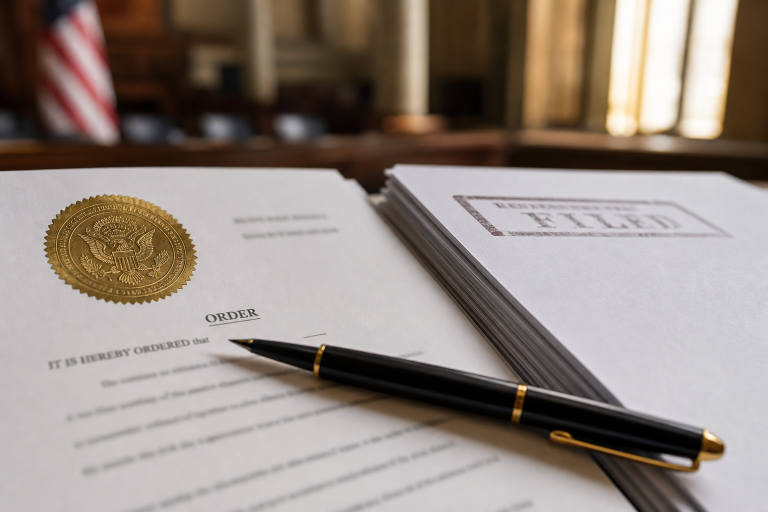
The remedy matters as much as the headline. A temporary restraining order is short-term emergency relief. A preliminary injunction may prevent enforcement of a challenged action while the court considers the merits. A stay pauses enforcement of a rule or pauses the effect of a lower-court decision, often during an appeal.
A final judgment may be entered after trial or by summary judgment, when the court concludes that no material factual dispute requires a trial. A permanent injunction can prohibit or require specific conduct after a final ruling. Cases can also end in settlement, which is an agreement between the parties and may include deadlines, policy changes, or ongoing reporting obligations.
Areas Most Often Affected
Voting And Election Administration
Voting cases may address registration procedures, ballot access, mail voting, election deadlines, voter-list practices, or documentation requirements. These disputes can be complex because federal law, state law, and local election administration may all be relevant.
Education
Education litigation may involve equal access, discrimination protections, federal grants, student records, school guidance, or agency interpretations. Schools should distinguish between a binding court order, a regulation with legal force, and nonbinding guidance or public statements.
Immigration And Citizenship
Immigration challenges can concern work authorization, protected status, detention practices, removal procedures, or citizenship-related rules. Emergency requests are common because a policy change may have immediate consequences for an individual’s ability to work, remain with family, or access services.
Employment And Public Services
Federal civil rights disputes can also affect workplace practices, housing, health programs, public benefits, and access to government-funded services. The Department of Justice’s civil rights work reflects the broad range of statutes that can shape enforcement and litigation in these areas.
How To Read Case Updates
- Identify the court. Note whether the matter is in a district court, appeals court, or the Supreme Court.
- Check the date. Separate the original filing date from the date of the newest order.
- Read the operative language. Determine exactly what the judge granted, denied, paused, or required.
- Confirm the scope. Look for limits involving particular plaintiffs, a class, a state, an agency program, or a defined policy.
- Find the next deadline. Appeals, hearings, briefing schedules, and settlement discussions can change the practical result.
What Schools, Employers, And Groups Should Do
Organizations affected by a court order should keep written records of policy decisions, review the exact order with qualified legal counsel, and avoid making changes based on incomplete news coverage. Staff should understand the applicable privacy, nondiscrimination, records retention, and complaint procedures. Clear communication with affected employees, students, clients, or community members can reduce confusion while the case remains pending.
How To Check Legal Claims
Start with the complaint, the most recent court order, and the docket entry describing the case’s current posture. Then compare reporting from multiple reputable outlets and confirm whether a ruling has been stayed or appealed. A claim that a policy was “blocked” may describe only temporary relief, a limited group of plaintiffs, or one portion of a larger policy.
Common Questions
Does A Lawsuit Automatically Stop A Government Policy?
No. A lawsuit begins the legal challenge, but a separate court order is generally needed to halt, delay, or limit enforcement while the case continues.
What Does A Preliminary Injunction Mean?
It is a temporary relief intended to preserve the status quo while the court evaluates the case. It is significant, but it is not necessarily the outcome.
Can A Ruling Affect People Outside The Case?
Sometimes. The answer depends on the wording of the order, whether a class was certified, and the legal relationship between the plaintiffs and the challenged government action.
Why Do These Cases Take Time?
Courts may need to resolve standing, gather evidence, interpret complex laws, consider emergency motions, and review appeals. Policy changes during litigation can also alter the issues before the court.
Conclusion
Civil rights litigation is a process, not a single court date or headline. The most reliable way to understand a case is to identify the challenged policy, read the court’s actual order, confirm who is covered, and watch for the next procedural step. That approach helps communities respond with care, accuracy, and a clearer understanding of what a ruling does and does not change.
