Table of Contents
- Understanding Warehouse Picking
- Challenges in Traditional Picking Methods
- Technological Advancements in Picking
- Best Practices for Implementing Picking Solutions
- Conclusion
Warehouse operations are the backbone of modern supply chains, supporting the ever-increasing demands of e-commerce and customer expectations for speed and accuracy. Streamlining the picking process is a powerful way to boost productivity and maintain the competitive edge required in today’s logistics landscape. Tools such as order picking carts can significantly simplify material handling and improve picker efficiency in many different types of facilities.
By implementing effective picking workflows and adopting advanced technologies, organizations can vastly improve their order fulfillment speed while minimizing error rates. Strategic optimization not only enhances operational efficiency but also directly translates to better customer satisfaction, reduced costs, and a more agile warehousing environment.
As businesses seek to scale, the challenges posed by manual picking practices and the opportunities offered by technological innovation become increasingly significant. This article explores core picking concepts, pinpoints challenges, examines the latest solutions reshaping warehouse operations, and highlights best practices for implementing these improvements.
Understanding Warehouse Picking
Warehouse picking is the process of locating and selecting items from a facility’s inventory to fulfill specific customer orders. This activity forms a critical link between inventory management and outbound logistics. In many warehouses, picking is one of the most labor-intensive steps, accounting for a sizable share of operating expenses.
A successful picking operation not only ensures rapid and accurate order fulfillment but also reduces unnecessary movement and handling. This is vital for both operational cost control and customer retention. For a deeper look at inventory management fundamentals, resources such as Peoplevox offer additional industry insights.
There are several different picking methods employed in warehouses, each with its own advantages tailored to the nature and volume of orders. Discrete picking, for example, involves fulfilling one order at a time and is often used in smaller warehouses. Batch picking, on the other hand, consolidates multiple orders that share common SKUs, reducing the number of trips needed to collect items from storage locations. Zone picking assigns workers to specific zones or areas, with each staff member responsible for picking certain SKUs in their designated region, thereby increasing efficiency in high-volume, larger facilities. Choosing the best picking strategy can yield significant improvements in throughput and order lead times.
Challenges in Traditional Picking Methods
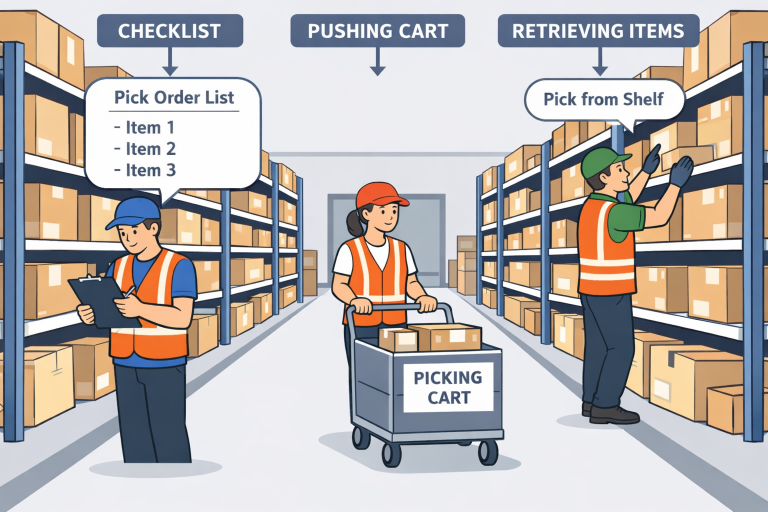
Traditional picking practices commonly rely on paper-based lists, manual cart use, and repetitive physical tasks. These approaches often lead to several issues, including higher error rates, longer picking times, and greater labor costs. Even small inaccuracies in order accuracy can undermine customer confidence and inflate operational expenses.
Labor remains a dominant warehouse expense. Studies show that labor costs can account for over half of a facility’s operating budget. This makes inefficiencies in picking one of the primary threats to warehouse profitability. Additionally, reliance on human memory and physical searching introduces inconsistency and lost productivity.
Fatigue and workplace injuries can arise in environments where inefficient routes require excessive walking, lifting, or repetitive motions. Over time, these patterns not only heighten safety risks but also contribute to increased staff absenteeism or turnover. Furthermore, manual systems often limit the ability to scale operations rapidly in response to seasonal demand spikes, potentially causing delays that affect customer satisfaction and brand reputation. Since traditional systems lack real-time visibility, managers may struggle to identify bottlenecks or accurately forecast resource needs, further compounding inefficiency across operations.
Technological Advancements in Picking
The rapid evolution of warehouse technology has significantly alleviated the pitfalls of purely manual picking. Modern facilities are increasingly adopting a combination of the following solutions:
- Pick-to-Light Systems: Using lights and visual signals, these systems direct staff to the exact locations for each item on a picking list. This sharply reduces search time and virtually eliminates certain types of picking errors.
- Voice-Directed Picking: Workers wear wireless headsets that provide audio instructions for each step in the process. This approach allows for hands-free operation, improving speed while keeping workers’ attention on safety and accuracy.
- Automated Storage and Retrieval Systems (AS/RS): These are computer-controlled systems that automatically store and retrieve inventory. AS/RS optimizes space and minimizes walking, saving up to 85% of floor space and reducing labor requirements by two-thirds. More information on the impact of automation can be found at Logisnext Americas.
- Autonomous Mobile Robots (AMRs): AMRs work alongside human staff to transport goods throughout the warehouse. They reduce the time staff spend pushing carts and allow pickers to focus on higher-order tasks, thereby increasing throughput.
Additionally, advanced warehouse management systems (WMS) now harness data analytics and real-time tracking to optimize pick routes and inventory positioning. This technology provides managers with immediate insights into operational flows, inventory status, and labor use, enabling much more responsive, data-driven decision-making. Combined with IoT devices, WMS can reduce manual checks and keep records continuously updated. Machine learning algorithms can further refine picking routes and slotting strategies, learning from historical picking patterns to continually boost efficiency.
Best Practices for Implementing Picking Solutions
- Assess Current Operations: Begin by thoroughly evaluating your existing picking processes. Identify key inefficiencies, bottlenecks, and error-prone steps in your workflow to guide where improvement is most critical.
- Choose Appropriate Technology: Select technology tailored to your warehouse’s specific requirements. Consider the volume of orders, product types, and the physical space available to ensure the new solutions provide real value.
- Integrate with Existing Systems: New picking technologies should be compatible with your warehouse management software and operational infrastructure. Seamless integration minimizes disruptions and allows staff to adopt new tools fluidly.
- Train Staff: Even the most advanced systems require adequately trained personnel for successful implementation. Ongoing education ensures staff remain engaged, adaptable, and capable of using the technology effectively.
- Monitor and Optimize: Continuously track key performance indicators (KPIs) such as picking accuracy, order cycle time, and labor costs. Periodic reassessment helps identify new opportunities for optimization as the business evolves.
It is also wise to foster a culture of continuous improvement, encouraging team members at all levels to suggest and implement efficiency gains. Piloting new tools with a small group before scaling across the entire operation can help identify practical adjustments or training needs. Communication, flexibility, and top-down support are crucial for successful long-term adoption of new strategies and technologies. Furthermore, collaboration among IT, operations, and human resources can accelerate troubleshooting, enabling challenges to be resolved efficiently when they arise.
Conclusion
Optimizing warehouse picking is a strategic priority for any organization aiming to improve efficiency, accuracy, and scalability. By embracing best practices and leveraging modern technologies, businesses can minimize costs, enhance order fulfillment, and deliver exceptional service in a fast-paced market. Future competitiveness depends on taking decisive action now to modernize and future-proof warehouse picking operations.
Ultimately, as customer expectations continue to rise and supply chains become more complex, warehouses must adapt by not only investing in top-tier technology but also maintaining a well-trained, agile workforce. Companies that implement robust picking strategies and are committed to ongoing improvement are best positioned to meet today’s demands while staying nimble for tomorrow’s opportunities. Whether your operation is considering its first automated system or planning transformational upgrades, focusing on granular process improvement and scalable solutions will ensure your warehouse is truly ready for growth and resilience.
