Key Takeaways
- An Ohio sobriety checkpoint stop is a seizure under constitutional law, but checkpoints are not automatically unlawful.
- Fighting an OVI case often means examining how the checkpoint was planned, operated, and documented.
- Stay calm, do not evade the checkpoint, do not lie, and avoid making unnecessary statements.
- Field sobriety tests, chemical tests, officer observations, videos, and dispatch records can all be important.
- An administrative license suspension and the criminal OVI charge may require separate attention.
- Quick action matters because court appearances and license-related deadlines can arrive early.
Table of Contents
- What to Do at the Checkpoint
- When a Checkpoint May Be Challenged
- Questioning the OVI Investigation
- Chemical Tests and License Consequences
- Evidence to Preserve Quickly
- Court, Suppression Motions, and Daily Life
- A Practical Checklist
A sobriety checkpoint can feel intimidating, especially when an officer directs every approaching driver to stop. A checkpoint stop does not automatically mean an arrest, a charge, or a conviction. Still, what happens during those few minutes can shape an Ohio OVI case. People facing allegations after a roadblock stop may want to discuss the facts with Gounaris Abboud before making decisions about pleas, license issues, or court strategy.
This guide explains lawful ways to challenge a sobriety checkpoint stop in Ohio. It is not a guide to avoiding police activity. Do not make an unsafe U-turn, ignore directions, flee, or physically resist an officer. Instead, focus on protecting your rights, preserving evidence, and carefully reviewing whether the government can prove that the checkpoint and later investigation were lawful.
What to Do at the Checkpoint
Pull forward as directed, keep your hands visible, and provide documents when asked. Be polite and brief. Do not argue about the checkpoint or volunteer details about yourself. If asked investigative questions, respond calmly, such as, “I would prefer not to answer.” Never lie. During arrest, ask for a lawyer and stop discussing the case. Your behavior and words may be recorded in reports or videos.
When a Checkpoint May Be Challenged
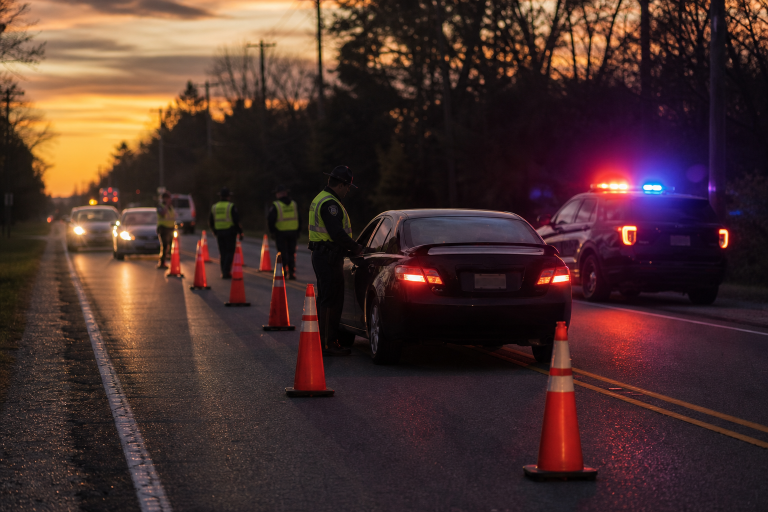
Ohio courts generally recognize that a properly conducted checkpoint can be constitutional. But a checkpoint must still satisfy constitutional limits. A defense may examine whether the checkpoint’s public-safety purpose outweighed the intrusion on drivers and whether officers used objective procedures rather than arbitrary choices.
Questions That May Matter
- Did supervisors approve a written operational plan before the checkpoint began?
- Did the plan identify the location, hours, purpose, staffing, and vehicle-selection method?
- Were officers stopping vehicles according to a neutral formula, such as every vehicle or every third vehicle?
- Did officers depart from that formula without a documented safety reason?
- Was the site clearly marked, adequately lit, and operated in a way that reduced surprise and fear?
- Did the checkpoint continue longer than the announced plan or operate differently from the plan?
Ohio law also limits citations for certain secondary traffic offenses during authorized sobriety checkpoints. The restrictions in Ohio’s checkpoint citation rule can matter when a citation arises from an alleged equipment, registration, or similar secondary violation.
Questioning the OVI Investigation
Even if the initial checkpoint is valid, the officer still needs a lawful basis to extend the encounter, investigate impairment, arrest a driver, or search a vehicle. A case may turn on what happened after the first brief contact. The officer may cite odor, red eyes, speech, admissions, driving behavior before the checkpoint, or performance on roadside tests.
Field Sobriety Tests Deserve Close Review
Field tests are not simple pass-or-fail exams. Physical limitations, footwear, uneven pavement, flashing emergency lights, poor lighting, weather, age, injuries, and medical conditions can affect performance. Review whether the officer gave clear instructions, demonstrated the test, selected a suitable location, and followed the required procedures. Ohio law addresses the evidentiary use of field sobriety testing in its OVI statute, including the need for substantial compliance with applicable testing standards.
Video can be especially useful. Body-camera footage may show that a driver was cooperative, spoke normally, followed directions, or had trouble only because of site conditions. It can also reveal discrepancies between what occurred and what was later reported.
Chemical Tests and License Consequences
After an arrest, Ohio’s implied-consent rules require choosing between breath, blood, urine, or oral fluid tests. Refusal or certain results can lead to license suspension independent of criminal charges. The decision depends on specific circumstances, so an arrested driver should not rely on roadside advice. A defense review may examine test timing, officer warnings, observation period, instrument used, maintenance, operator qualifications, sample handling, lab procedures, and if results match records. Individuals might also choose to obtain an independent chemical test at their own expense, but failing to do so doesn’t preclude the state test.
Do Not Ignore the License Issue
An administrative license suspension may be appealed at the initial appearance or within 30 days after that appearance. The appeal has limited grounds, and filing it does not automatically pause the suspension. Read every notice closely, calendar the court date, and ask promptly about possible limited driving privileges.
Evidence to Preserve Quickly
Memories fade, and recordings can be overwritten. As soon as possible, write a detailed timeline. Include when you arrived at the checkpoint, what officers said, the sequence of tests, the names or badge numbers you observed, and whether passengers or other drivers saw the interaction.
- Save citations, tow receipts, temporary license documents, and bond paperwork.
- Identify possible dash-camera, body-camera, cruiser-camera, and nearby business video.
- Photograph the checkpoint area, roadway, lighting, signs, and surface conditions later, if safely possible.
- Keep medical records that may explain balance, speech, mobility, or eye-related symptoms.
- Preserve receipts, location data, and messages that establish the timing of events.
- Do not delete posts, texts, photos, or vehicle data related to the incident.
Court, Suppression Motions, and Daily Life
A meaningful challenge may begin with a motion to suppress evidence. Depending on the facts, the motion can question the checkpoint’s constitutionality, the officer’s reason for extending the stop, the basis for arrest, a search, statements, field tests, or chemical-test procedures. A successful motion can limit evidence, but every case depends on its own testimony, records, and video.
Keep the criminal case and driving status organized separately. Missing court, driving while suspended, or discussing the case online can create avoidable problems. Plan transportation, notify only people who need to know, and keep all court notices in one secure folder.
A Practical Post-Checkpoint Checklist
- Follow release conditions and confirm the next court date.
- Write down a complete timeline while details are fresh.
- Preserve paperwork, electronic records, and witness contact information.
- Do not post about the stop or debate the facts with others.
- Verify your driving status before driving again.
- Review the checkpoint plan, videos, reports, test records, and license paperwork with qualified counsel.
Fighting a sobriety checkpoint stop in Ohio is usually about disciplined fact-finding, not confrontation. Careful review of the checkpoint operation, the officer’s investigation, testing procedures, and the licensing process can identify issues worth raising and help you make informed decisions about the case.
